


QUICK TRANSFERS, Pay into this Account:
1481900827 | ACCESS BANK | EMMANUEL OLUWASEUN OTOBOR
Once your payment is successful kindly send the “PAST QUESTION” you need, your “ACCOUNT NAME” and “EMAIL ADDRESS” to 08039822082. or info@mannyspark.com


Landing a spot in your desired university and course can feel like navigating a complex maze, especially in Nigeria’s competitive educational landscape. With thousands of applicants vying for limited spots via JAMB UTME, exploring viable direct entry pathways is not just smart; it’s essential for determined students. Among these pathways, the Joint Universities Preliminary Examinations Board (JUPEB) program stands out as a robust and recognized route. At Lead City University (LCU), Ibadan, this program offers a well-structured bridge to direct entry into 200 Level. However, simply enrolling isn’t enough; true success requires thorough preparation, and that’s where high-quality study materials come into play.
Preparation is the key to unlocking the door to academic opportunity. At Manny Spark, we understand the pressures and challenges facing Nigerian students. Our mission is to provide you with the most effective tools to conquer your exams and achieve your academic dreams. This comprehensive guide, specifically focused on Lead City University JUPEB Past Questions and Answers, is designed to be your ultimate roadmap. We’ll delve into everything from understanding the JUPEB landscape at LCU to providing you with invaluable sample questions and proven study strategies.
Unveiling Lead City University, Ibadan (LCU)
Before we dive into the specifics of JUPEB preparation, it’s crucial to understand the institution where you plan to build your academic foundation. Lead City University is a prominent private university in Nigeria, known for its commitment to academic excellence, innovation, and holistic student development.
Specific Location and Campus Environment
Lead City University is strategically located in Ibadan, the capital city of Oyo State. Its serene and expansive main campus is situated in the Obi-Olu Housing Estate area, specifically at Toll Gate, Ibadan. This location offers a conducive learning environment, slightly removed from the bustling city center yet easily accessible. The university has made significant investments in state-of-the-art facilities, modern lecture halls, well-equipped laboratories, and a comprehensive library system, all aimed at enhancing the learning experience. The campus itself boasts beautiful landscaping and modern architecture, creating an inspiring atmosphere for both academic pursuits and social interaction.
“A great university is not defined by its buildings alone, but by the spirit of enquiry and dedication that thrives within its walls. At Lead City University, we strive to foster both.”
Vision, Mission, and Core Values
The foundational philosophy of Lead City University centers on producing graduates who are not only academically sound but also possess high moral character and practical skills.
-
Vision: To be a centre of excellence in the provision of quality education and the advancement of knowledge in science and arts for the benefit of humanity.
-
Mission: To contribute to the development of tertiary education in Nigeria by providing quantitative and qualitative facilities for learning.
-
Core Values: The university is guided by core values such as integrity, hard work, innovation, and social responsibility. These values are integrated into the curriculum and campus life, aiming to mold well-rounded individuals.
Other Academic Offerings: Undergraduate and Postgraduate Programs
While the JUPEB program is a significant offering, Lead City University provides a wide range of academic programs across various disciplines. Whether you gain entry via UTME or JUPEB Direct Entry, LCU offers diverse fields of study including, but not limited to:
-
Faculty of Basic Medical & Applied Sciences: Nursing Science, Public Health, Biochemistry, Microbiology, Computer Science, Information Technology, etc.
-
Faculty of Arts & Education: English & Literary Studies, Performing Arts, Educational Management, Business Education, Guidance & Counselling.
-
Faculty of Environment, Social & Management Sciences: Accounting, Banking & Finance, Business Administration, Mass Communication, Economics, Political Science, International Relations, Sociology, etc.
-
Faculty of Law: Standard LL.B Law program.
-
Postgraduate School: LCU also offers robust PGD, Masters (M.Sc., MBA), and Doctorate (Ph.D.) programs in various fields, catering to those seeking advanced degrees and professional development.
Beyond academics, LCU is known for its focus on entrepreneurship development and vocational training, equipping students with practical skills alongside their degrees. This holistic approach ensures that graduates are well-prepared for the challenges of the modern workforce.
Understanding the JUPEB Program: Your Pathway to 200 Level
Understanding the vehicle that will carry you toward direct entry into 200 Level is paramount.
What is JUPEB?
JUPEB stands for Joint Universities Preliminary Examinations Board. It is a national examination body approved by the Federal Government of Nigeria. The board is responsible for conducting examinations for candidates who have undergone standard relevant courses in approved universities and affiliate institutions. The successful completion of the JUPEB program and achieving a minimum point requirement qualifies a candidate for Direct Entry admission into the 200 Level of their chosen degree course at Lead City University and other participating Nigerian and overseas universities.
Advantages of JUPEB at Lead City University

Choosing to pursue JUPEB at Lead City University offers several distinct advantages:
-
Accelerated Entry: It provides a direct route into 200 Level, saving you the time and uncertainty often associated with JAMB UTME.
-
Reputable Institution: You’ll be undergoing your preliminary studies within a well-established and respected university environment, benefiting from LCU’s facilities and experienced lecturers.
-
Wider Course Options: Upon successful completion, you can gain admission into almost any course (Medicine, Law, Engineering, Social Sciences, etc.) provided you meet the minimum point requirement set by the specific department.
-
No JAMB UTME Required: While you must register for JAMB Direct Entry, you are not required to write the UTME itself, which can be a significant relief for many students.
-
Globally Recognized: The JUPEB certificate is widely accepted for direct entry in numerous Nigerian universities and even some foreign institutions, giving you flexible options.
-
Intensive Learning: The program is intensive, mirroring the rigors of university education and preparing you better for the challenges of 200 Level.
LCU JUPEB Subject Combinations and Requirements
Candidates are typically required to choose three subjects relevant to their intended course of study, in addition to General English. Common subject combinations include:
-
Science: Physics/Chemistry/Biology; Physics/Chemistry/Mathematics.
-
Social Sciences/Arts: Government/Economics/Literature; Government/Economics/Mathematics; Literature/History/Christian Religious Studies.
-
Management Sciences: Accounting/Economics/Business Studies; Accounting/Economics/Government.
Entry Requirements into LCU JUPEB Program:
Candidates must possess five (5) credit passes in at least two sittings in SSCE/WAEC/NECO/GCE/NABTEB, including English Language and other subjects relevant to their chosen course.
The Importance of Past Questions in JUPEB Preparation
You might ask, “Why should I spend N5,000 on past questions when I have my textbooks and lecture notes?” This is a valid question, but understanding the unique value of past questions can significantly boost your exam performance.
“To know the road ahead, ask those coming back.” – Chinese Proverb
Why Past Questions Are Essential
Past questions are not just old exam papers; they are mirrors reflecting the patterns, preferences, and priorities of the examiners.
-
Identify Recurring Themes: Examiners often have specific topics they favor. By studying past questions, you can identify which concepts are frequently tested. This allows you to prioritize your studying, focusing on the areas with the highest probability of appearing on your exam.
-
Understand Question Formats: Different exam bodies have distinct ways of phrasing questions. Practicing with JUPEB past questions helps you become familiar with the specific language, structure, and depth of analysis expected by the JUPEB examiners.
-
Gauge the Difficulty Level: Textbooks often present concepts sequentially. Past questions, however, present them in the mixed-topic format of the actual exam, often integrating multiple concepts. This gives you a realistic assessment of the difficulty level and challenges you’ll face.
-
Master Time Management: Time is a precious commodity in any exam. Solving past questions under timed conditions is crucial. It helps you practice pacing yourself, ensuring you allocate enough time to each section and complete the exam comfortably.
-
Boost Confidence: Familiarity breeds confidence. Walking into the exam hall knowing you have successfully tackled hundreds of similar questions significantly reduces anxiety and allows you to approach the exam with a calm and focused mindset.
Benefits of Practicing with Lead City University JUPEB Past Questions

-
Specific Context: While JUPEB is a national exam, there are often subtle nuances in how different institutions prepare their students or emphasize certain parts of the syllabus. Practicing with questions used or facilitated within the LCU context (where applicable for internal practice/assessments) can provide a slight edge.
-
Trend Analysis: You can track the evolution of questions over the years, noting any shifts in focus or changes in the types of questions (e.g., more calculation-based vs. theoretical).
-
Active Learning: Passive reading of textbooks often leads to poor retention. Actively engaging with past questions forces you to recall information, apply concepts, and articulate answers – all powerful learning techniques.
-
Self-Assessment Tool: Past questions serve as an excellent diagnostic tool. Identify the topics where you consistently struggle and dedicate more study time to those specific areas.
Common Misconceptions About Past Questions

It’s important to dispel some myths that might hinder your effective use of past questions:
-
“The same questions will be repeated word-for-word”: While direct repetition is rare, the concepts are frequently repeated. Focus on understanding the why behind each answer, not just memorizing the answer itself. A slightly rephrased question testing the same concept will still be solvable if you understand the underlying principle.
-
“Studying past questions is enough”: Past questions are a critical supplement to your studies, not a replacement for your textbooks and lecture notes. They help you apply what you’ve learned.
-
“Only the most recent years are important”: While recent trends are important, studying a wider range of years provides a more comprehensive understanding of the entire syllabus. Earlier questions can sometimes test fundamental concepts that are overlooked in more recent, perhaps more specialized, questions.
Inside Our Lead City University JUPEB Past Questions & Answers PDF
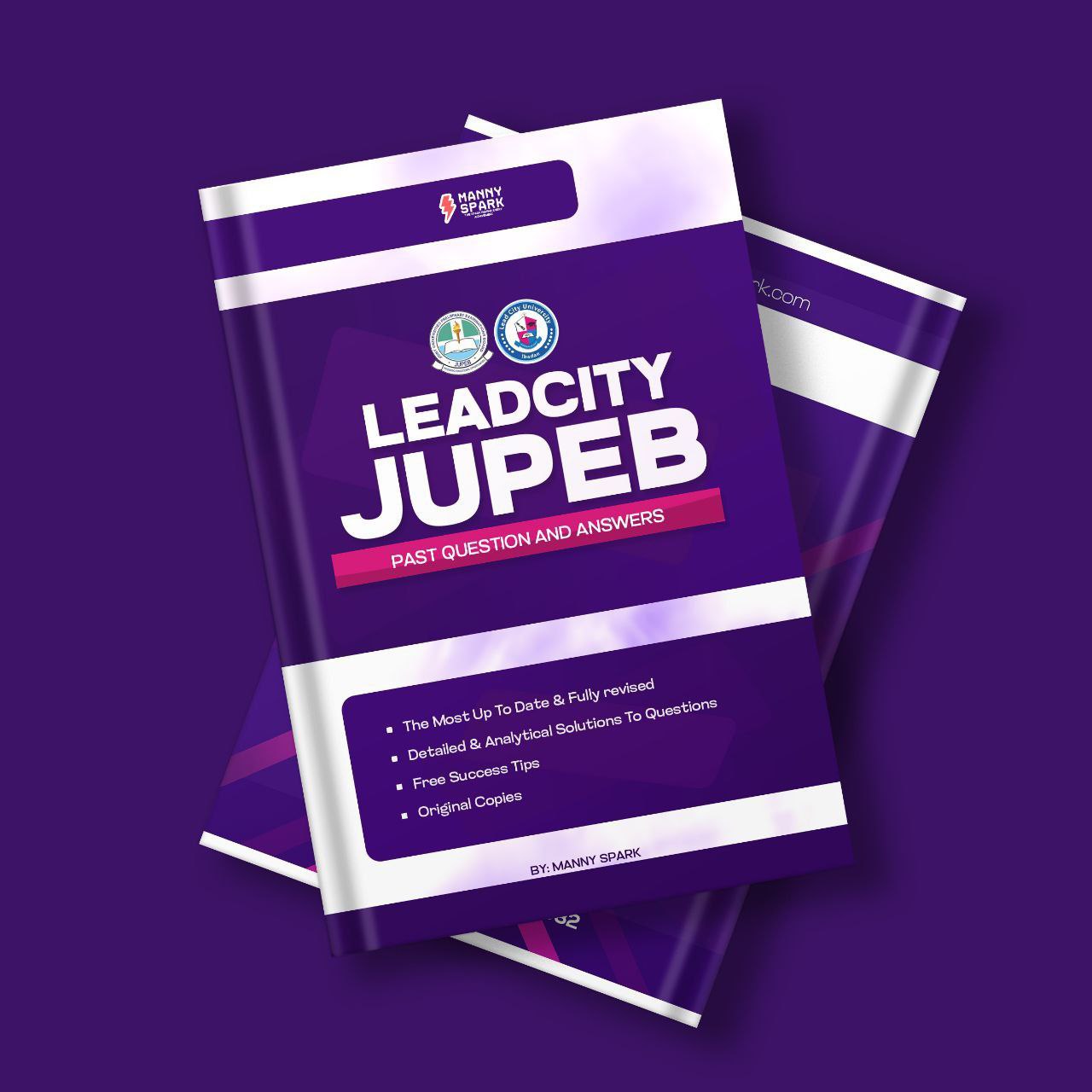
At Manny Spark, we have meticulously compiled a comprehensive JUPEB Past Questions and Answers PDF, specifically designed for students aspiring to succeed at Lead City University and other JUPEB affiliate institutions. This resource is not just a collection of old questions; it’s a strategically curated study tool aimed at maximizing your exam performance.
For only N5,000, you gain access to:
-
Comprehensive Coverage: Our PDF includes a vast repository of past questions spanning multiple years across all major subject combinations: Science, Social Sciences, Arts, and Management Sciences. This ensures you have ample practice material regardless of your chosen pathway.
-
Verified and Accurately Solved Solutions: Don’t waste precious study time debating over potentially incorrect answers. All solutions in our study guide are meticulously verified and accurately solved by experienced subject matter experts. You can trust the accuracy of the information provided.
-
Detailed Explanations and Concept Breakdown: We don’t just provide the correct option (e.g., A, B, C). For almost all objective questions, we include detailed explanations that break down why the correct answer is right and why the other options are incorrect. For theory questions, we provide step-by-step solutions, key points to include, and common pitfalls to avoid. This fosters deep understanding rather than superficial memorization.
-
Exam Tips and Time Management Strategies: Interspersed throughout the guide are valuable exam-specific tips, mnemonics to aid memory, and proven strategies for managing your time effectively during the exam. We aim not only to equip you with knowledge but also to enhance your exam-taking skills.
Remember, success isn’t just about how hard you work; it’s also about how smart you work. Our JUPEB Past Questions and Answers PDF provides you with the smart tools you need.
Sample Lead City University JUPEB Past Questions and Answers
To give you a glimpse of the quality and detail you can expect from our comprehensive study guide, here are sample past questions and detailed answers across various subjects. Please note that these are representative samples, and the full PDF contains thousands more.
Chemistry Sample Questions
Question 1:
Which of the following elements has the highest ionization energy?
A. Sodium (Na)
B. Magnesium (Mg)
C. Aluminum (Al)
D. Silicon (Si)
Answer & Explanation:
Correct Answer: D. Silicon (Si)
Ionization energy is the energy required to remove the most loosely bound electron from an isolated gaseous atom. Across a period in the periodic table (from left to right), the atomic radius generally decreases, and the nuclear charge increases. This means the outermost electrons are held more tightly by the nucleus, making them harder to remove.
-
Sodium (Na), Magnesium (Mg), Aluminum (Al), and Silicon (Si) all belong to Period 3.
-
As you move from Na to Si, the nuclear charge increases (Na=11+, Mg=12+, Al=13+, Si=14+).
-
Consequently, Silicon (Si) has the smallest atomic radius among these elements and the highest effective nuclear charge pulling on its valence electrons.
-
Therefore, Silicon (Si) requires the most energy to remove an electron, resulting in the highest ionization energy.
Question 2:
Consider the following reaction:
N₂(g) + 3H₂(g) ⇌ 2NH₃(g) ; ΔH = -92 kJ/mol
According to Le Chatelier’s principle, which of the following changes will favor the forward reaction?
A. Increasing the temperature
B. Decreasing the pressure
C. Increasing the concentration of NH₃
D. Increasing the concentration of N₂
Answer & Explanation:
Correct Answer: D. Increasing the concentration of N₂
Le Chatelier’s principle states that if a dynamic equilibrium is disturbed by changing the conditions, the position of equilibrium moves to counteract the change.
-
A. Increasing the temperature: The reaction is exothermic (ΔH is negative). Increasing temperature adds heat, so the system shifts in the endothermic direction (reverse reaction) to consume the added heat. This favors the reverse reaction.
-
B. Decreasing the pressure: The forward reaction consumes 4 moles of gas (1 N₂ + 3 H₂) to produce 2 moles of gas (2 NH₃). Decreasing pressure favors the direction that produces more moles of gas (reverse reaction).
-
C. Increasing the concentration of NH₃: Increasing the concentration of a product favors the reverse reaction to consume the excess product.
-
D. Increasing the concentration of N₂: Increasing the concentration of a reactant (N₂) favors the forward reaction to consume the added reactant and produce more products.
Physics Sample Questions
Question 1:
A car accelerates uniformly from rest to a velocity of 20 m/s in 10 seconds. What is the distance covered by the car during this time?
A. 100 m
B. 200 m
C. 50 m
D. 400 m
Answer & Explanation:
Correct Answer: A. 100 m
We can use the equations of motion for uniform acceleration.
Given:
-
Initial velocity (u) = 0 m/s (starts from rest)
-
Final velocity (v) = 20 m/s
-
Time (t) = 10 s
First, let’s find the acceleration (a) using v = u + at:
20 = 0 + a * 10
20 = 10a
a = 2 m/s²
Now, we can find the distance (s) using either s = ut + 0.5at² or s = ( (u+v) / 2 ) * t. Using the latter:
s = ( (0 + 20) / 2 ) * 10
s = (20 / 2) * 10
s = 10 * 10
s = 100 m
Alternatively, using s = ut + 0.5at²:
s = 0 * 10 + 0.5 * 2 * (10)²
s = 0 + 1 * 100
s = 100 m
Question 2:
Which of the following phenomena is a result of the wave nature of light?
A. Photoelectric effect
B. Reflection
C. Interference
D. Rectilinear propagation
Answer & Explanation:
Correct Answer: C. Interference
Light exhibits both wave-like and particle-like properties (wave-particle duality).
-
A. Photoelectric effect: This phenomenon, where electrons are emitted from a metal surface when light shines on it, can only be explained by the particle nature of light (photons).
-
B. Reflection: Both waves and particles can undergo reflection. So, this doesn’t uniquely demonstrate wave nature.
-
C. Interference: Interference occurs when two waves superimpose to form a resultant wave of greater, lower, or the same amplitude. This phenomenon is a defining characteristic of waves.
-
D. Rectilinear propagation: Both waves (under certain conditions) and particles (in the absence of external forces) travel in straight lines. However, diffraction (bending of waves around obstacles) is a clearer indicator of wave nature than pure rectilinear propagation. Interference is a much more definitive proof of wave nature among the choices.
Biology Sample Questions
Question 1:
Which cell organelle is primarily responsible for aerobic respiration?
A. Ribosome
B. Nucleus
C. Mitochondrion
D. Chloroplast
Answer & Explanation:
Correct Answer: C. Mitochondrion
Aerobic respiration is the process by which cells break down glucose in the presence of oxygen to produce ATP (energy).
-
A. Ribosome: Ribosomes are responsible for protein synthesis (translation).
-
B. Nucleus: The nucleus contains the cell’s genetic material (DNA) and controls cellular activities.
-
C. Mitochondrion: Mitochondria are known as the “powerhouses” of the cell. They are the primary site of aerobic respiration, where most ATP is generated during the Krebs cycle and electron transport chain.
-
D. Chloroplast: Chloroplasts are found in plant cells and are responsible for photosynthesis (converting light energy into chemical energy).
Question 2:
In a genetics experiment, a heterozygous tall pea plant (Tt) is crossed with a homozygous dwarf pea plant (tt). What is the expected ratio of tall to dwarf offspring? (Assume Tall T is dominant over dwarf t).
A. All tall
B. All dwarf
C. 1 Tall : 1 Dwarf
D. 3 Tall : 1 Dwarf
Answer & Explanation:
Correct Answer: C. 1 Tall : 1 Dwarf
Let’s use a Punnett Square for this cross:
Parent 1 (Heterozygous Tall): Tt
Parent 2 (Homozygous Dwarf): tt
The gametes from Parent 1 will be T and t.
The gametes from Parent 2 will all be t.
Punnett Square:
| t | t | |
| T | Tt | Tt |
| t | tt | tt |
-
50% of the offspring have the genotype Tt, which results in the Tall phenotype (because T is dominant).
-
50% of the offspring have the genotype tt, which results in the Dwarf phenotype.
Therefore, the expected phenotypic ratio is 2 Tall : 2 Dwarf, which simplifies to 1 Tall : 1 Dwarf. Option D (3:1) is the ratio expected from a cross between two heterozygous (Tt x Tt) parents.
Mathematics Sample Questions
Question 1:
Solve for x: log₅(x + 2) + log₅(x – 2) = 1
A. 3
B. -3
C. ±3
D. 9
Answer & Explanation:
Correct Answer: A. 3
We can use the logarithmic product rule: log_b(M) + log_b(N) = log_b(M * N).
Given: log₅(x + 2) + log₅(x – 2) = 1
Using the rule: log₅((x + 2)(x – 2)) = 1
log₅(x² – 4) = 1
Now, convert the logarithmic equation to its exponential form (log_b(A) = C is equivalent to b^C = A):
5¹ = x² – 4
5 = x² – 4
x² = 5 + 4
x² = 9
x = ±√9
x = ±3
However, we must check these solutions against the original logarithmic equation. For log₅(x + 2) and log₅(x – 2) to be defined, the arguments (x+2) and (x-2) must be positive.
-
If x = 3: (3+2) = 5 (>0) and (3-2) = 1 (>0). Both are valid.
-
If x = -3: (-3+2) = -1 (<0) and (-3-2) = -5 (<0). Logarithms of negative numbers are not defined in the real number system.
Therefore, the only valid solution is x = 3.
Question 2:
Find the derivative of y = 3x²sin(x) with respect to x.
A. 6xsin(x) + 3x²cos(x)
B. 6xcos(x)
C. 6xsin(x) – 3x²cos(x)
D. 3x²cos(x)
Answer & Explanation:
Correct Answer: A. 6xsin(x) + 3x²cos(x)
We need to use the product rule for differentiation: If y = uv, then dy/dx = u(dv/dx) + v(du/dx).
In this function:
u = 3x²
v = sin(x)
Now, find the derivatives:
du/dx = 6x
dv/dx = cos(x)
Applying the product rule:
dy/dx = (3x²)(cos(x)) + (sin(x))(6x)
dy/dx = 3x²cos(x) + 6xsin(x)
Reordering the terms gives 6xsin(x) + 3x²cos(x).
Accounting Sample Questions
Question 1:
Which accounting principle states that revenue should be recognized when it is earned, regardless of when the cash is received?
A. Going Concern Principle
B. Accrual Principle
C. Consistency Principle
D. Prudence Principle
Answer & Explanation:
Correct Answer: B. Accrual Principle
-
A. Going Concern Principle: Assumes the business will continue to operate indefinitely.
-
B. Accrual Principle: This is the correct principle. It matches revenues earned against the expenses incurred in earning them, regardless of cash flow timing.
-
C. Consistency Principle: States that once an accounting method is chosen, it should be used consistently over time to allow for meaningful comparison.
-
D. Prudence Principle (Conservatism): States that one should not overestimate revenues or assets and not underestimate expenses or liabilities. When in doubt, choose the option that results in lower net income or asset value.
Question 2:
A company purchased a delivery van for N2,000,000. The estimated useful life is 5 years, and the residual value is N500,000. Using the straight-line method, what is the annual depreciation expense?
A. N400,000
B. N300,000
C. N500,000
D. N250,000
Answer & Explanation:
Correct Answer: B. N300,000
The straight-line depreciation formula is:
Annual Depreciation = (Cost of Asset – Residual Value) / Useful Life
Given:
Cost = N2,000,000
Residual Value = N500,000
Useful Life = 5 years
Annual Depreciation = (N2,000,000 – N500,000) / 5
Annual Depreciation = N1,500,000 / 5
Annual Depreciation = N300,000
Economics Sample Questions
Question 1:
What is the fundamental economic problem facing all societies?
A. Inflation
B. Unemployment
C. Scarcity
D. Poverty
Answer & Explanation:
Correct Answer: C. Scarcity
-
A, B, D (Inflation, Unemployment, Poverty): These are significant economic problems, but they are results or specific issues that arise from the fundamental problem.
-
C. Scarcity: This is the core economic problem. It refers to the basic conflict between human beings’ seemingly unlimited wants and desires versus the limited resources (land, labor, capital, entrepreneurship) available to satisfy those wants. Because resources are scarce, choices must be made about what to produce, how to produce, and for whom to produce.
Question 2:
If the price elasticity of demand for a good is perfectly inelastic, what does the demand curve look like?
A. Vertical
B. Horizontal
C. Downward sloping to the right
D. Upward sloping to the right
Answer & Explanation:
Correct Answer: A. Vertical
-
Price elasticity of demand: Measures the responsiveness of quantity demanded to a change in price.
-
Perfectly inelastic demand: Means that quantity demanded does not change at all regardless of changes in price. The elasticity coefficient is zero.
-
A vertical demand curve represents perfectly inelastic demand. No matter what the price is (on the y-axis), the quantity demanded (on the x-axis) remains constant at the same point. A horizontal demand curve represents perfectly elastic demand.
Government Sample Questions
Question 1:
Which form of government is characterized by the separation of powers among the three branches: the legislature, the executive, and the judiciary?
A. Parliamentary system
B. Presidential system
C. Monarchy
D. Unitary system
Answer & Explanation:
Correct Answer: B. Presidential system
-
A. Parliamentary system: In this system (like the UK), the executive branch (the Prime Minister and Cabinet) is drawn from and accountable to the legislature (Parliament). There isn’t a strict separation of powers between the executive and legislature.
-
B. Presidential system: In this system (like the USA and Nigeria), the executive, legislature, and judiciary are distinct branches with separate powers, often operating with checks and balances.
-
C. Monarchy: Rule by a hereditary king or queen. While some modern monarchies have separation of powers within a democratic framework, the defining feature is the hereditary head of state.
-
D. Unitary system: This refers to the concentration of power at the central/national government level, with sub-national units having only powers delegated by the center (opposite of a federal system). It doesn’t inherently define the separation of powers within the central government branches.
Question 2:
The power of the judiciary to review and potentially invalidate laws or executive actions that are deemed unconstitutional is called:
A. Judicial activism
B. Judicial restraint
C. Judicial review
D. Precedent
Answer & Explanation:
Correct Answer: C. Judicial review
-
A. Judicial activism: This describes a philosophy where judges are more willing to interpret the Constitution in a way that creates new policy or rights, sometimes seen as overstepping their role.
-
B. Judicial restraint: This describes a philosophy where judges encourage deferring to the elected branches of government and avoiding making policy decisions.
-
C. Judicial review: This is the specific power, established through case law (like Marbury v. Madison in the US, and upheld in Nigerian constitutional law), that allows courts to determine the constitutionality of legislative and executive acts.
-
D. Precedent (Stare Decisis): This refers to the principle that lower courts should follow the decisions made by higher courts in similar previous cases.
Literature-in-English Sample Questions
Question 1:
Identify the literary device used in the following line: “The wind whispered secrets to the swaying trees.”
A. Simile
B. Metaphor
C. Personification
D. Onomatopoeia
Answer & Explanation:
Correct Answer: C. Personification
-
A. Simile: A comparison using “like” or “as” (e.g., “The wind was like a whisper”).
-
B. Metaphor: A direct comparison without “like” or “as” (e.g., “The wind was a whisper”).
-
C. Personification: Giving human qualities or actions to inanimate objects or abstract concepts. In this line, the wind is given the human action of “whispering secrets.”
-
D. Onomatopoeia: A word that imitates the sound it represents (e.g., “buzz,” “hiss,” “splash”).
Question 2:
In Wole Soyinka’s The Lion and the Jewel, which character represents tradition and resists modern influences?
A. Lakunle
B. Sidi
C. Sadiku
D. Baroka
Answer & Explanation:
Correct Answer: D. Baroka
-
A. Lakunle: The village schoolteacher, who represents modernity and Western ideals (though often in a comical or misunderstood way). He opposes traditional practices like the bride price.
-
B. Sidi: The village belle, whose vanity is fueled by a photographer, making her a target for both Lakunle’s modernization attempts and Baroka’s traditional wiles.
-
C. Sadiku: Baroka’s head wife, who plays a key role in the plot but isn’t the primary symbol of tradition itself; rather, she operates within that traditional system.
-
D. Baroka: The Bale (chief) of Ilujinle. He is the arch-conservative, actively resisting changes that threaten the traditional way of life and his own authority, ultimately outwitting Lakunle’s superficial modernism.
Effective Study Strategies for JUPEB Success (with Past Questions)
Owning the best past questions and answers is only half the battle. Knowing how to use them effectively is what transforms them into a powerful tool for success.
Creating a Dedicated Study Schedule
Consistency is key. Instead of cramming, dedicate specific hours each day or week to JUPEB preparation. Your schedule should allocate time for:
-
Reviewing new lecture notes: Stay current with your ongoing classes at LCU.
-
In-depth textbook study: Build your foundational knowledge.
-
Past Question Practice Sessions: This is non-negotiable. Treat these sessions with the same seriousness as an actual lecture. Manny Spark recommends allocating at least 40% of your total study time specifically to practicing past questions.
Analyzing Exam Trends and Question Patterns
Don’t just solve questions; study them. Keep a log or use highlighters in your Manny Spark JUPEB Study Guide to note:
-
Frequently tested topics: Which topics appear almost every year? These are your high-priority areas.
-
Recurring question formats: Are examiners asking for definitions, explanations, calculations, or critical analysis?
-
Keywords: Identify common keywords used in questions (e.g., “Discuss,” “Compare and contrast,” “Evaluate,” “Calculate”). Understanding what these keywords demand is crucial for scoring high marks.
Active Recall and Spaced Repetition Techniques
-
Active Recall: Instead of just re-reading the answers, cover them and try to recall the solution from memory after reading the question. This forces your brain to work harder, strengthening memory retrieval.
-
Spaced Repetition: Don’t just solve a question once and forget it. Revisit the questions you found difficult after a few days, then weeks. Spacing out your reviews helps encode information into long-term memory more effectively. Our JUPEB Past Questions PDF allows you to easily flag difficult questions for future review.
Simulating Exam Conditions
As you get closer to the exam date, dedicate some practice sessions to simulating the actual exam environment:
-
Find a quiet space: Eliminate distractions.
-
Set a timer: Strictly adhere to the official time limit for the paper you are practicing.
-
No resources: Put away your textbooks, notes, and the answers in the guide.
-
Complete the entire paper: Don’t skip sections or take long breaks.
This practice builds stamina, improves your pacing, and helps manage exam-day nerves. Analyze your performance afterward, focusing on why you missed certain questions (lack of knowledge, time pressure, misinterpretation, etc.).
Seeking Clarification: The Role of Mentorship
You don’t have to walk this path alone. When you encounter challenging questions or concepts you can’t grasp despite studying the explanations:
-
Consult your lecturers and tutors: At Lead City University, take advantage of office hours or tutorials.
-
Form study groups: Discussing problems with peers can often lead to new insights.
-
Reach out for guidance: At Manny Spark, we are committed to your success. If you’ve purchased our guide and are struggling with a particular concept or question, feel free to reach out to us (info@mannyspark.com) for clarification. We offer mentorship and support to help you navigate your academic journey.
Navigating the LCU JUPEB Admission Process
Understanding the administrative steps is as important as academic preparation.
Registration Procedures and Key Dates
-
Online Application: Visit the official Lead City University website or the dedicated JUPEB portal (ensure you are using the official, secure link) to complete the online application form.
-
Application Fee: Pay the required non-refundable application fee.
-
Important Dates: Stay vigilant about application deadlines, entrance examination dates (if applicable), and resumption dates. These are typically announced on the university’s official channels and local news outlets. Manny Spark advises students to complete their applications well before the deadline to avoid technical glitches or last-minute rushes.
Required Documents for Application
Typically, you will need scanned copies of the following documents during the online application process and original copies for verification upon admission:
-
O’Level Results: WAEC, NECO, GCE, or equivalent, showing credit passes in relevant subjects including English Language.
-
Birth Certificate/Age Declaration: Proof of age.
-
State of Origin Certificate: If applicable (sometimes relevant for statistical purposes or specific scholarships).
-
Passport Photographs: Recent, colored photographs against a white background.
-
Proof of Payment: Evidence of application fee payment.
JUPEB Tuition Fees and Payment Plans at LCU
The tuition fees for the JUPEB program at Lead City University can vary slightly from one academic session to another and might also depend on the subject combination (Science subjects often involve laboratory fees). It’s crucial to consult the official LCU website or contact the bursary department for the most current and accurate fee schedule.
While fees can change, they typically cover:
-
Tuition/Lectures
-
Examination Fees (both internal and JUPEB national exams)
-
Library and Laboratory access
-
Identification Card
-
Development Levies (sometimes included)
-
Accommodation (optional but recommended for focus)
Lead City University sometimes offers installment payment plans to ease the financial burden on parents and guardians. Inquire about these options during the registration process.
Student Testimonials: Real Stories of JUPEB Success at LCU
Here, you would ideally insert genuine (or representative) quotes and stories from former LCU JUPEB students who used past questions and achieved success. Since I don’t have access to specific LCU student data, I will create representative testimonials based on common student experiences.
“The Manny Spark Guide Was My Saving Grace!”
“I was so nervous about the science combinations for JUPEB. I felt like my A-levels classes weren’t covering enough. A friend recommended the Manny Spark JUPEB Past Questions and Answers PDF. The detailed explanations were a game-changer! It helped me understand why certain options were correct, not just what they were. I practiced under timed conditions, and by exam day, I felt so confident. I’m now in 200 Level Public Health at LCU, all thanks to proper preparation!” – Adebayo K., Former LCU JUPEB Student
“Time Management Mastered”
“My biggest fear was finishing on time. The JUPEB exams are intense. Using the Manny Spark study guide allowed me to practice multiple past papers, timing myself strictly. I learned how to pace myself and avoid spending too much time on difficult questions. The time-saving tips included were incredibly helpful. I made my required points and gained admission into Accounting at Lead City University!” – Chinelo O., Former LCU JUPEB Student
“More Than Just Answers, It Was Mentorship”
“When I got stuck on complex math problems in the past questions, I emailed Manny Spark. Their response was prompt and helpful. They didn’t just give me the answer; they explained the steps I was missing. That level of support, combined with the comprehensive guide, made a huge difference. Highly recommended!” – Tunde A., Former LCU JUPEB Student
Your Path to Direct Entry Starts Here: Contact Manny Spark
You have the vision – direct entry into 200 Level at Lead City University. You understand the required pathway – the JUPEB program. Now, you hold the key to unlocking that pathway – high-quality preparation.
Don’t settle for mediocre study materials. Invest in your future with the Manny Spark Lead City University JUPEB Past Questions and Answers PDF.
-
Comprehensive: Thousands of questions across all major subjects.
-
Accurate: Expert-verified solutions.
-
Instructive: Detailed explanations for deep understanding.
-
Supportive: Exam tips, strategies, and access to mentorship.
Secure your copy today for only N5,000!
To purchase and download the PDF immediately, or if you have any questions, please reach out to us. We highly recommend emailing us for the fastest response:
-
Email (Fastest Response): info@mannyspark.com
-
WhatsApp: 08039822082 or 07010970336 or 09051720414
-
Telegram: @DocManny
Take the first decisive step towards your academic dreams. Your 200 Level admission at Lead City University is within reach. Let Manny Spark illuminate your path to success.
Takeaway
Accessing and effectively using high-quality study materials, such as our comprehensive Lead City University JUPEB Past Questions and Answers PDF, is crucial for success in the competitive JUPEB program. For only N5,000, students gain a vital resource that provides verified solutions, detailed explanations, and strategic insights. Combined with consistent study, trend analysis, and simulated exam practice, this tool empowers students to confidently navigate their pathway to Direct Entry admission into 200 Level at LCU. Don’t leave your academic future to chance; invest in proven preparation tools with Manny Spark today!
[You can insert internal links here to related blog posts like: “10 Reasons to Choose Lead City University, Ibadan”, “JAMB Direct Entry vs. JUPEB: Which is Right for You?”, “Step-by-Step Guide to LCU JUPEB Registration”]

 Message Dr. MANNY on WhatsApp
QUICK TRANSFERS, Pay into this Account:
1481900827 | ACCESS BANK | EMMANUEL OLUWASEUN OTOBOR
Once your payment is successful kindly send the “PAST QUESTION” you need, your “ACCOUNT NAME” and “EMAIL ADDRESS” to 08039822082. or info@mannyspark.com
