


Federal Teaching Hospital IdoEkiti School of Nursing Past Questions and Answers

QUICK TRANSFERS, Pay into this Account:
1481900827 | ACCESS BANK | EMMANUEL OLUWASEUN OTOBOR
Once your payment is successful kindly send the “PAST QUESTION” you need, your “ACCOUNT NAME” and “EMAIL ADDRESS” to 08039822082. or info@mannyspark.com


Federal Teaching Hospital IdoEkiti School of Nursing Past Questions and Answers
In the dynamic landscape of healthcare education in Nigeria, securing admission into a reputable school of nursing is a significant milestone for aspiring healthcare professionals. The Federal Teaching Hospital Ido-Ekiti School of Nursing has long been recognized as a key institution in training competent nurses who contribute immensely to the nation’s health sector. As competition intensifies, with thousands of candidates vying for limited spots each year, preparation becomes paramount. This is where access to reliable past questions and answers plays a crucial role.
Brought to you by Dr. Manny of Manny Spark, this in-depth guide delves into the essentials of preparing for the entrance examination. With over a decade of experience in educational resources for Nigerian students, Manny Spark specializes in providing verified, up-to-date materials that have helped countless individuals achieve their dreams. Our updated PDF compilation includes hundreds of past questions spanning multiple years, complete with detailed explanations to enhance understanding.
Preparation is not just about studying hard; it’s about studying smart. As noted in a recent report on nursing education in Nigeria, “The admission process demands a blend of academic prowess and strategic preparation to stand out.” This article will cover the school’s background, location, programs, admission intricacies, study strategies, extensive sample questions, and more. Whether you’re a secondary school leaver or a career changer, this resource is tailored to equip you for success in the 2025 exam cycle.

According to Dr. Aisha Bello, a nursing educator in Ekiti State, “The journey to becoming a nurse begins with mastering the entrance exam, which tests not just knowledge but application in real-world scenarios.” By the end of this guide, you’ll have a clear path forward.
History of Nursing Education in Nigeria
Nursing education in Nigeria has evolved significantly since its colonial beginnings in the early 20th century. The first formal nursing school was established in 1949 at the University College Hospital in Ibadan, marking the start of structured training. Over the decades, the Nursing and Midwifery Council of Nigeria (NMCN) has standardized programs, ensuring they align with global best practices.
In the context of federal institutions like the Federal Teaching Hospital Ido-Ekiti, nursing education gained momentum with the establishment of teaching hospitals in the 1970s and 1980s. These hospitals integrated clinical training with academic rigor, producing registered nurses (RNs) capable of handling diverse healthcare challenges. By the 2000s, reforms introduced diploma and degree programs, with schools like Ido-Ekiti emphasizing community health to address rural-urban disparities.
Today, with over 200 approved schools of nursing across Nigeria as per NMCN records, the focus is on evidence-based practice and technology integration. Challenges such as funding and infrastructure persist, but institutions like Federal Teaching Hospital Ido-Ekiti continue to adapt, offering programs that prepare nurses for roles in primary, secondary, and tertiary care. This historical foundation underscores the importance of rigorous entrance exams to maintain high standards.
For more on NMCN-approved schools, visit Nursing and Midwifery Council of Nigeria.
About Federal Teaching Hospital Ido-Ekiti School of Nursing
The Federal Teaching Hospital Ido-Ekiti, formerly known as the Federal Medical Centre, was upgraded to a teaching hospital status in 2014 by former President Goodluck Jonathan. This elevation positioned it as a hub for advanced medical education in Ekiti State. The School of Nursing, affiliated with the hospital, has a legacy of excellence, though recent updates indicate a shift away from basic nursing admissions. Despite this, its historical programs remain a benchmark for aspiring nurses.
The school focuses on holistic training, blending theory with practical skills in a multidisciplinary environment. Graduates are registered with the NMCN, enabling them to practice nationwide. Dr. Manny of Manny Spark has curated resources based on verified exam patterns from previous years, ensuring relevance even as policies evolve.

“Teaching hospitals like Ido-Ekiti are vital for producing nurses who can innovate in Nigeria’s healthcare system,” states Prof. Oladipo from the Ekiti State University Teaching Hospital.
Location and Facilities in Ido-Ekiti
Ido-Ekiti, nestled in the Ido-Osi Local Government Area of Ekiti State, is strategically positioned about 20 kilometers northwest of Ado-Ekiti, the state capital. With coordinates approximately 7.845° N and 5.183° E, it’s accessible via major roads like the Ado-Ekiti-Ido-Ekiti highway, connecting to Lagos (about 300km away) and other southwestern states. The town’s population, predominantly Yoruba, thrives on agriculture and education, providing a peaceful backdrop for learning.
The Federal Teaching Hospital spans a vast campus with annexes in Ado-Ekiti, Ise-Ekiti, and Igogo-Ekiti, extending services through outreach to communities like Otun and Emure. Facilities include state-of-the-art operating theaters (over 1,000 surgeries performed), specialized departments in obstetrics, orthopedics, and mental health, and a 24/7 emergency unit. For nursing students, amenities encompass simulation labs, anatomy dissection rooms, a well-stocked library with digital resources, and hostel accommodations.
The hospital’s partnership with the National Health Insurance Scheme (NHIS) ensures affordable care, covering up to 90% of costs for insured patients. This integration of education and service makes Ido-Ekiti an ideal location for hands-on nursing training, fostering empathy for underserved populations.

Programs and Offerings at the School
Historically, the Federal Teaching Hospital Ido-Ekiti School of Nursing offered a three-year diploma in General Nursing, leading to RN certification. The curriculum covered foundational courses like anatomy, physiology, pharmacology, and clinical rotations in pediatrics, surgery, and community health. Post-basic programs in midwifery and public health nursing were also available, spanning 12-18 months.
Admission quotas, as per NMCN guidelines, typically allowed 50-100 students per intake. Requirements included five O’Level credits in English, Mathematics, Biology, Chemistry, and Physics. While basic admissions have ceased, the hospital continues refresher courses and collaborations with nearby institutions like Ekiti State University Teaching Hospital for advanced training.
Manny Spark‘s resources include past questions adaptable to similar programs. For internal links, explore Nursing Programs in Southwestern Nigeria.
“Programs here emphasize ethical nursing, preparing graduates for global opportunities,” shares a former instructor.
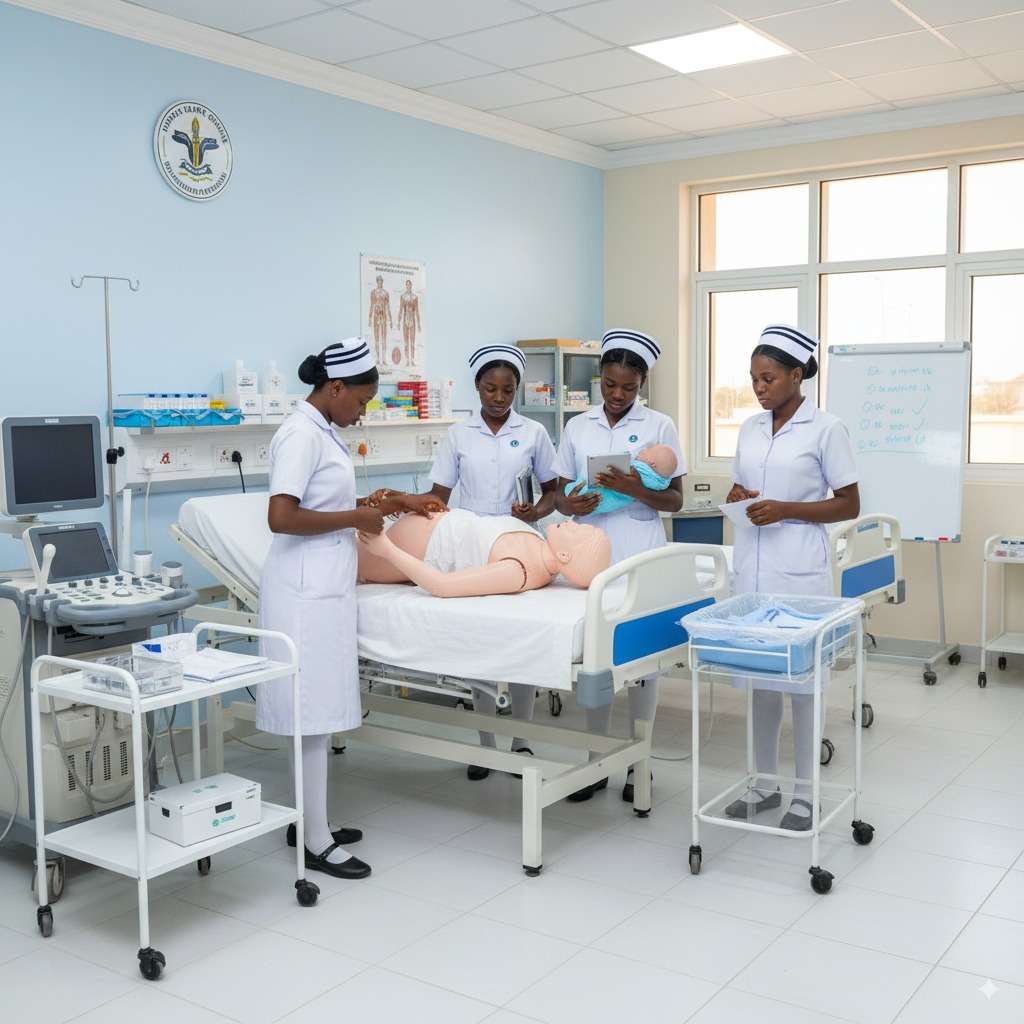
Admission Process for Schools of Nursing in Nigeria
The admission process for Nigerian schools of nursing, including those like Federal Teaching Hospital Ido-Ekiti, is multifaceted. It begins with obtaining the application form, often online or via designated banks, costing around N11,000. Candidates must meet O’Level requirements and sometimes UTME scores, though many focus on internal exams.
The entrance exam, typically multiple-choice, covers English, Mathematics, Biology, Chemistry, and Physics. Successful candidates proceed to oral interviews assessing communication and motivation. Final selection considers merit, with quotas for indigenes.
Navigating this process requires diligence, as over 900 candidates sat for Ido-Ekiti’s exam in 2019. For tips, see our internal link to Admission Strategies for Nigerian Nursing Schools.
Why Past Questions Are Essential for Entrance Exam Preparation
Past questions demystify the exam format, revealing patterns like recurring topics in Biology (e.g., human systems) or Chemistry (e.g., reactions). In Nigeria, where exams are competitive, studies show that practicing past papers boosts scores by 50-70%.
They aid in time management, reducing anxiety, and highlighting knowledge gaps. Dr. Manny recommends daily practice sessions. Without them, preparation is incomplete.
Study Tips for Nursing Entrance Exams in Nigeria
Effective preparation involves a structured plan. For Biology, focus on diagrams and processes; use mnemonics for systems. In Chemistry, practice equations daily. Physics requires understanding laws through examples. English: Build vocabulary via reading. Math: Master basics like percentages for dosages.
General tips: Create a timetable, take practice tests, join study groups, and seek tutors if needed. Consistency is key—study 4-6 hours daily.

Sample Past Questions: English Language
English assesses grammar, comprehension, and vocabulary. Below is an expanded table with 20 samples:
| Question Number | Question | Options | Correct Answer |
|---|---|---|---|
| 1 | Choose the opposite of “benevolent.” | A) Kind B) Malevolent C) Generous D) Friendly | B) Malevolent |
| 2 | The teacher asked students to _____ instructions. | A) Read B) Reads C) Reading D) Readed | A) Read |
| 3 | Synonym of “meticulous.” | A) Careless B) Precise C) Hasty D) Lazy | B) Precise |
| 4 | Adverb in “The nurse cared diligently.” | A) Nurse B) Cared C) Patient D) Diligently | D) Diligently |
| 5 | Neither doctor nor nurses _____ available. | A) Is B) Are C) Was D) Were | B) Are |
| 6 | Passive: “Student answered question.” | A) Question was answered by student B) Student was answered C) Answered by student D) Question answered | A) Question was answered by student |
| 7 | Correct spelling: | A) Accomodation B) Accommodation C) Acomodation D) Accomadation | B) Accommodation |
| 8 | “Kick the bucket” means: | A) Play football B) Die C) Work D) Eat | B) Die |
| 9 | Antonym of “abundant.” | A) Plentiful B) Scarce C) Rich D) Full | B) Scarce |
| 10 | Comprehension: Main idea of healthcare passage. | A) Food B) Nurses’ importance C) Weather D) Sports | B) Nurses’ importance |
| 11 | Choose the correct preposition: He is good _____ mathematics. | A) In B) At C) On D) With | B) At |
| 12 | Identify the noun: “Honesty is the best policy.” | A) Is B) Best C) Honesty D) Policy | C) Honesty |
| 13 | Synonym of “ephemeral.” | A) Eternal B) Transient C) Permanent D) Lasting | B) Transient |
| 14 | Fill in: She _____ to the market yesterday. | A) Go B) Goes C) Went D) Going | C) Went |
| 15 | Antonym of “diligent.” | A) Lazy B) Hardworking C) Active D) Energetic | A) Lazy |
| 16 | The book belongs to _____. | A) She B) Her C) Hers D) Herself | B) Her |
| 17 | Idiom: “Piece of cake” means: | A) Dessert B) Easy task C) Hard work D) Food | B) Easy task |
| 18 | Correct sentence: “Neither of the boys are coming.” | A) Is B) Are C) Was D) Were | A) Is |
| 19 | Synonym of “ubiquitous.” | A) Rare B) Everywhere C) Limited D) Scarce | B) Everywhere |
| 20 | Comprehension: Theme of a nursing ethics story. | A) Dishonesty B) Integrity C) Laziness D) Greed | B) Integrity |
These reflect patterns from past exams. The full PDF has 100+ questions.
Sample Past Questions: Mathematics
Mathematics emphasizes calculations relevant to nursing.
| Question Number | Question | Options | Correct Answer |
|---|---|---|---|
| 1 | Simplify: 2x + 3x – 5x. | A) 0 B) 10x C) -0x D) 5x | A) 0 |
| 2 | 15% of 200. | A) 30 B) 20 C) 15 D) 300 | A) 30 |
| 3 | Solve: 4x – 8 = 12. | A) 5 B) 4 C) 6 D) 2 | A) 5 |
| 4 | Area of rectangle 10cm x 5cm. | A) 50cm² B) 15cm² C) 30cm² D) 20cm² | A) 50cm² |
| 5 | 0.75 as fraction. | A) 3/4 B) 1/2 C) 4/3 D) 2/3 | A) 3/4 |
| 6 | Dosage: 2mg/kg for 50kg. | A) 100mg B) 25mg C) 50mg D) 200mg | A) 100mg |
| 7 | Square root of 144. | A) 12 B) 14 C) 10 D) 16 | A) 12 |
| 8 | (3 + 5) × 2 – 4. | A) 12 B) 14 C) 10 D) 16 | A) 12 |
| 9 | Third angle in 90°, 45° triangle. | A) 45° B) 90° C) 135° D) 0° | A) 45° |
| 10 | 5 apples N100, cost for 20. | A) N400 B) N200 C) N500 D) N300 | A) N400 |
| 11 | Mean of 2, 4, 6, 8. | A) 5 B) 6 C) 4 D) 20 | A) 5 |
| 12 | Convert 3/4 to decimal. | A) 0.75 B) 0.5 C) 0.25 D) 1.0 | A) 0.75 |
| 13 | Volume of cube side 3cm. | A) 9cm³ B) 27cm³ C) 6cm³ D) 12cm³ | B) 27cm³ |
| 14 | Solve: x² = 16. | A) 4 B) -4 C) Both A&B D) 0 | C) Both A&B |
| 15 | 20% discount on N500. | A) N100 B) N400 C) N500 D) N600 | B) N400 |
| 16 | Ratio 2:3 for 10 parts. | A) 4:6 B) 2:3 C) 5:5 D) 6:4 | A) 4:6 |
| 17 | Perimeter of square side 5cm. | A) 20cm B) 25cm² C) 10cm D) 15cm | A) 20cm |
| 18 | 1/2 + 1/3. | A) 5/6 B) 2/5 C) 3/5 D) 1/6 | A) 5/6 |
| 19 | Interest: P=1000, R=5%, T=2yrs. | A) 100 B) 200 C) 50 D) 1000 | A) 100 |
| 20 | Mode of 1,2,2,3,4. | A) 2 B) 1 C) 3 D) 4 | A) 2 |
Practice for accuracy in medical math.

Sample Past Questions: Biology
Biology focuses on life sciences.

| Question Number | Question | Options | Correct Answer |
|---|---|---|---|
| 1 | Cell powerhouse. | A) Nucleus B) Mitochondria C) Ribosome D) Wall | B) Mitochondria |
| 2 | Red blood cells function. | A) Infection B) Oxygen C) Clot D) Digest | B) Oxygen |
| 3 | Photosynthesis in. | A) Animals B) Plants C) Fungi D) Bacteria | B) Plants |
| 4 | Heart chambers. | A) 2 B) 3 C) 4 D) 5 | C) 4 |
| 5 | DNA full form. | A) Deoxyribonucleic Acid B) Ribonucleic Acid C) Deoxyribose Nucleus D) Daily Nucleic | A) Deoxyribonucleic Acid |
| 6 | Blood filter organ. | A) Liver B) Kidney C) Heart D) Lungs | B) Kidney |
| 7 | Malaria cause. | A) Virus B) Bacteria C) Parasite D) Fungus | C) Parasite |
| 8 | Cell division. | A) Mitosis B) Photosynthesis C) Respiration D) Digestion | A) Mitosis |
| 9 | Sunlight vitamin. | A) A B) B C) C D) D | D) D |
| 10 | Largest organ. | A) Brain B) Skin C) Liver D) Heart | B) Skin |
| 11 | Enzymes are. | A) Proteins B) Carbs C) Lipids D) Minerals | A) Proteins |
| 12 | Respiratory exchange. | A) Food B) Water C) Gases D) Blood | C) Gases |
| 13 | Sickle cell affects. | A) Bones B) Blood C) Muscles D) Eyes | B) Blood |
| 14 | Pollination in. | A) Roots B) Leaves C) Flowers D) Stems | C) Flowers |
| 15 | Life unit. | A) Atom B) Cell C) Tissue D) Organ | B) Cell |
| 16 | Osmosis is. | A) Diffusion of water B) Gas exchange C) Active transport D) Phagocytosis | A) Diffusion of water |
| 17 | Endocrine gland: Pancreas produces. | A) Insulin B) Adrenaline C) Thyroxine D) Cortisol | A) Insulin |
| 18 | Ecosystem top: | A) Producers B) Consumers C) Decomposers D) Apex predators | D) Apex predators |
| 19 | Mendel’s law: | A) Segregation B) Gravity C) Motion D) Relativity | A) Segregation |
| 20 | HIV attacks: | A) Red cells B) White cells C) Platelets D) Neurons | B) White cells |
| 21 | Plant hormone for growth: | A) Auxin B) Cytokinin C) Gibberellin D) All | D) All |
| 22 | Human skeleton bones: | A) 206 B) 300 C) 150 D) 250 | A) 206 |
| 23 | Respiration type without oxygen: | A) Aerobic B) Anaerobic C) Both D) None | B) Anaerobic |
| 24 | Eye part for light focus: | A) Retina B) Lens C) Cornea D) Iris | B) Lens |
| 25 | Food chain starts with: | A) Herbivores B) Carnivores C) Producers D) Omnivores | C) Producers |
| 26 | Nitrogen fixation by: | A) Bacteria B) Fungi C) Algae D) Viruses | A) Bacteria |
| 27 | Brain part for balance: | A) Cerebrum B) Cerebellum C) Medulla D) Hypothalamus | B) Cerebellum |
| 28 | Vaccine for polio: | A) Oral B) Injection C) Both D) None | C) Both |
| 29 | Ecology study of: | A) Cells B) Organisms and environment C) Genes D) Atoms | B) Organisms and environment |
| 30 | Mitosis phases: | A) 4 B) 5 C) 3 D) 2 | A) 4 |
Expanded for deeper practice.
Sample Past Questions: Chemistry
Chemistry covers fundamentals.
| Question Number | Question | Options | Correct Answer |
|---|---|---|---|
| 1 | Carbon atomic number. | A) 6 B) 8 C) 12 D) 14 | A) 6 |
| 2 | H2O means. | A) 2H 1O B) 1H 2O C) 2He 1O D) HO | A) 2H 1O |
| 3 | Acids turn litmus. | A) Blue B) Red C) Green D) Yellow | B) Red |
| 4 | Neutral pH. | A) 0 B) 7 C) 14 D) 5 | B) 7 |
| 5 | Noble gas. | A) O B) He C) C D) N | B) He |
| 6 | Combustion needs. | A) O B) N C) C D) H | A) O |
| 7 | Salt formula. | A) NaCl B) KCl C) HCl D) NaOH | A) NaCl |
| 8 | Organic studies. | A) Metals B) Carbon C) Gases D) Acids | B) Carbon |
| 9 | Metal not replacing H from water. | A) Na B) Mg C) Fe D) Cu | D) Cu |
| 10 | Electrolysis separates. | A) Compounds B) Elements C) Mixtures D) Atoms | A) Compounds |
| 11 | Water boiling point. | A) 0°C B) 100°C C) 212°F D) B&C | D) B&C |
| 12 | Catalysts do. | A) Speed reactions B) Evaporate C) Freeze D) Melt | A) Speed reactions |
| 13 | Isotopes same. | A) Atomic no. B) Mass no. C) Electrons D) Neutrons | A) Atomic no. |
| 14 | Bases feel. | A) Slippery B) Rough C) Sticky D) Dry | A) Slippery |
| 15 | Periodic table by. | A) Mass B) Atomic no. C) Density D) Color | B) Atomic no. |
| 16 | Alkali metals group. | A) 1 B) 2 C) 17 D) 18 | A) 1 |
| 17 | Bond in NaCl. | A) Covalent B) Ionic C) Metallic D) Hydrogen | B) Ionic |
| 18 | Avogadro’s number. | A) 6.02×10^23 B) 3.14 C) 9.8 D) 1.6×10^-19 | A) 6.02×10^23 |
| 19 | Oxidation is. | A) Gain electrons B) Loss electrons C) Gain protons D) Loss neutrons | B) Loss electrons |
| 20 | pH of acid rain. | A) <7 B) >7 C) 7 D) 14 | A) <7 |
| 21 | Hydrocarbon saturated. | A) Alkane B) Alkene C) Alkyne D) Aromatic | A) Alkane |
| 22 | Le Chatelier’s principle. | A) Equilibrium shift B) Speed C) Temperature D) Pressure | A) Equilibrium shift |
| 23 | Molar mass H2O. | A) 18 B) 16 C) 2 D) 20 | A) 18 |
| 24 | Halogens group. | A) 1 B) 2 C) 17 D) 18 | C) 17 |
| 25 | Buffer resists. | A) pH change B) Temperature C) Volume D) Color | A) pH change |
| 26 | Polymer example. | A) Plastic B) Metal C) Gas D) Liquid | A) Plastic |
| 27 | Radioactivity unit. | A) Becquerel B) Joule C) Watt D) Amp | A) Becquerel |
| 28 | Esterification. | A) Acid + alcohol B) Acid + base C) Base + salt D) Metal + acid | A) Acid + alcohol |
| 29 | Boyle’s law. | A) P V constant B) V T constant C) P T constant D) None | A) P V constant |
| 30 | Valency of oxygen. | A) 1 B) 2 C) 3 D) 4 | B) 2 |
Essential for drug chemistry understanding.
Sample Past Questions: Physics
Physics tests principles.
| Question Number | Question | Options | Correct Answer |
|---|---|---|---|
| 1 | Force unit. | A) Newton B) Joule C) Watt D) Ampere | A) Newton |
| 2 | Speed = distance /. | A) Time B) Mass C) Volume D) Energy | A) Time |
| 3 | Earth gravity. | A) 9.8 m/s² B) 10 m/s² C) 5 m/s² D) 0 | A) 9.8 m/s² |
| 4 | Light travels as. | A) Waves B) Particles C) Both D) Neither | C) Both |
| 5 | Ohm’s: V =. | A) IR B) I/R C) R/I D) V/I | A) IR |
| 6 | Sun energy. | A) Kinetic B) Potential C) Solar D) Chemical | C) Solar |
| 7 | Eye lens. | A) Convex B) Concave C) Flat D) Spherical | A) Convex |
| 8 | Sound no travel in. | A) Air B) Water C) Vacuum D) Metal | C) Vacuum |
| 9 | Work = Force ×. | A) Distance B) Time C) Mass D) Acceleration | A) Distance |
| 10 | Power unit. | A) Watt B) Joule C) Newton D) Pascal | A) Watt |
| 11 | Reflection on. | A) Mirrors B) Lenses C) Prisms D) All | A) Mirrors |
| 12 | Gravity affects. | A) Falling B) Stationary C) Floating D) None | A) Falling |
| 13 | Current in. | A) Volts B) Amps C) Ohms D) Watts | B) Amps |
| 14 | Radiation no need. | A) Medium B) Contact C) Both D) Neither | C) Both |
| 15 | Newton’s 1st law. | A) Inertia B) Acceleration C) Reaction D) Gravity | A) Inertia |
| 16 | Momentum = mass ×. | A) Velocity B) Acceleration C) Force D) Distance | A) Velocity |
| 17 | Lens for myopia. | A) Convex B) Concave C) Bifocal D) None | B) Concave |
| 18 | Kinetic energy formula. | A) 1/2 mv² B) mv C) mgh D) Fd | A) 1/2 mv² |
| 19 | Wave speed = frequency ×. | A) Wavelength B) Amplitude C) Period D) Phase | A) Wavelength |
| 20 | Transformer steps up/down. | A) Voltage B) Current C) Power D) Energy | A) Voltage |
| 21 | Archimedes’ principle. | A) Buoyancy B) Gravity C) Motion D) Inertia | A) Buoyancy |
| 22 | SI unit pressure. | A) Pascal B) Newton C) Joule D) Watt | A) Pascal |
| 23 | Relativity by. | A) Newton B) Einstein C) Galileo D) Kepler | B) Einstein |
| 24 | Capacitor stores. | A) Charge B) Current C) Voltage D) Power | A) Charge |
| 25 | Doppler effect. | A) Frequency change B) Speed C) Amplitude D) Phase | A) Frequency change |
| 26 | Nuclear fission. | A) Split atoms B) Fuse atoms C) Decay D) Absorb | A) Split atoms |
| 27 | Ohm’s law exception. | A) Diodes B) Resistors C) Capacitors D) Inductors | A) Diodes |
| 28 | Terminal velocity. | A) Constant speed fall B) Acceleration C) Zero speed D) Infinite | A) Constant speed fall |
| 29 | Thermodynamics 1st law. | A) Energy conservation B) Entropy C) Heat flow D) Work | A) Energy conservation |
| 30 | Electromagnetic spectrum includes. | A) Radio to gamma B) Sound C) Mechanical D) All | A) Radio to gamma |
These aid in equipment knowledge.
How to Get the Federal Teaching Hospital IdoEkiti School of NursingUpdated Past Questions from Manny Spark

Securing your copy of the Manny Spark Federal Teaching Hospital IdoEkiti School of Nursing past questions and answers PDF is simple and straightforward. Follow these steps to get started:
To get your PDF copy, please reach out via:
Phone: 08039822082
Email: Info@Mannyspark.com
PRICE: N5,000
💻 Quick Purchase Link
[button color=”primary” size=”medium” link=”https://api.whatsapp.com/send/?phone=2348039822082&text=DR+MANNY+I+WANT+TO+BUY+FEDERAL+TEACHING+HOSPITAL+IDOEKITI+SCHOOL+OF+NURSING+PAST+QUESTIONS” icon=”” target=”false” nofollow=”false”]CLICK HERE TO BUY FEDERAL TEACHING HOSPITAL IDOEKITI SCHOOL OF NURSING PAST QUESTIONS AND ANSWERS[/button]
Common Mistakes to Avoid in Entrance Exams
Common pitfalls include poor time management, neglecting diagrams in Biology, and calculation errors in Math. Avoid guessing without elimination; read questions carefully. Overstudying one subject at the expense of others is a frequent error. Practice under timed conditions.
Success Stories from Past Candidates
Many have succeeded using past questions. For instance, Adeola from Lagos scored 85% after using similar resources, securing admission. “The samples mirrored the exam,” she says. Another, Chinedu, improved from 40% to 75% through daily practice. These stories inspire persistence.
Frequently Asked Questions
Q: Is the school still admitting for basic nursing? A: Recent notices indicate a pause, but past questions remain useful for similar exams.
Q: What subjects are tested? A: English, Math, Biology, Chemistry, Physics.
Q: How to contact for more info? A: Reach Dr. Manny at 08039822082 or 09051720414.
Key Takeaways for Aspiring Nursing Students
- Prioritize Balanced Study: Cover all subjects equally.
- Use Reliable Resources: Manny Spark‘s PDF for authentic questions.
- Understand Application: Relate topics to nursing practice.
- Stay Updated: Check official sites for changes.
- Embrace Challenges: Nursing demands resilience.
- Practice Daily: Build confidence through repetition.
Related posts:




 Message Dr. MANNY on WhatsApp
QUICK TRANSFERS, Pay into this Account:
1481900827 | ACCESS BANK | EMMANUEL OLUWASEUN OTOBOR
Once your payment is successful kindly send the “PAST QUESTION” you need, your “ACCOUNT NAME” and “EMAIL ADDRESS” to 08039822082. or info@mannyspark.com
