



QUICK TRANSFERS, Pay into this Account:
1481900827 | ACCESS BANK | EMMANUEL OLUWASEUN OTOBOR
Once your payment is successful kindly send the “PAST QUESTION” you need, your “ACCOUNT NAME” and “EMAIL ADDRESS” to 08039822082. or info@mannyspark.com


2027 WASSCE Updated Typewriting Syllabus
Across secondary schools and tutorial centers in Nigeria, the West African Examinations Council (WAEC) offers Typewriting as a critical vocational subject. Designed to bridge foundational keyboarding mechanics with professional office administration, this subject equips candidates with the exact competencies needed in modern corporate secretaryship, data processing, and executive support roles. As experienced commercial educators frequently emphasize, “Keyboard fluency is not merely about striking keys quickly; it is the cognitive translation of raw thoughts into polished, executive-ready documentation under stringent time limits.”
For Senior School Certificate Examination (SSCE) candidates—whether school candidates or private GCE entrants—securing and studying a reliable Typewriting WAEC PDF is one of the most effective ways to guarantee a distinction. Whether your examination center utilizes traditional mechanical typewriters or computerized workstations configured to strict examination guidelines, mastering the core formatting rules, spacing conventions, and speed benchmarks remains the ultimate key to success.
2. Unpacking the WAEC Typewriting Syllabus and Marking Scheme

2027 WASSCE Updated Typewriting Syllabus
Achieving an A1 or B2 grade in WAEC Typewriting demands strict adherence to the official examination syllabus and grading criteria. Candidates are evaluated across three main competency areas: speed building, accurate document production, and manuscript interpretation.
As seasoned examination markers often point out, “The majority of candidates lose crucial marks not because they type too slowly, but because they violate standard vertical spacing rules, misalign margins, or overlook proofreader correction marks.”
| Examination Paper | Core Focus Area | Standard Duration | Target Performance Benchmark |
| Paper 1: Speed Test | Timed straight-copy typing | 10 minutes | Minimum 35 to 40 words per minute (wpm) with near-zero errors |
| Paper 2: Practical Exam | Business letters, memos, tables, and reports | 2 hours | Flawless execution of British and American business formats |
| Integrated Section | Manuscript decoding and proofing | Embedded in Paper 2 | 100% accurate interpretation of editor’s correction signs |
Candidates must master foundational touch-typing, standard paper measurements (such as A4 and quarto sizes), and official WAEC penalty calculation rules.
3. Essential Equipment, Ergonomics, and Workstation Setup

2027 WASSCE Updated Typewriting Syllabus
Your physical environment directly dictates your typing endurance, speed consistency, and overall accuracy. Poor posture during long study and practice sessions triggers rapid muscular fatigue in the wrists, shoulders, and lower back, leading to avoidable typographical errors.
-
Ergonomic Seating: Adjust your chair so your feet rest flat on the floor, with your knees bent at a comfortable 90-degree angle and your forearms parallel to the keyboard desk.
-
Manuscript Holder Positioning: Place your copy holder directly beside your screen or machine at eye level to prevent constant neck strain and erratic line-skipping.
-
Optimal Lighting: Ensure glare-free illumination over your desk so you can effortlessly read dense handwritten rough drafts and fine print without eye fatigue.
“A well-organized workstation transforms a stressful, exhausting practice session into a smooth, repeatable flow of productive keystrokes.”
4. Proven Keyboarding Techniques: Speed, Accuracy, and Drills
2027 WASSCE Updated Typewriting Syllabus
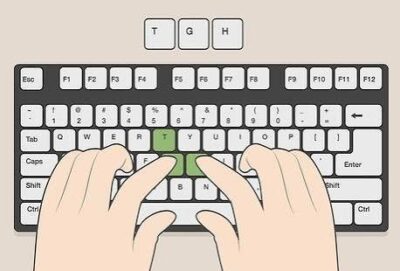
Building high words-per-minute (wpm) speeds while keeping error rates remarkably low is the primary hurdle for Nigerian students. Under WAEC regulations, every spelling error, missed punctuation mark, or improper spacing subtracts heavily from your raw score.
-
Strict Touch-Typing Discipline: Keep your fingers anchored firmly on the home row (
ASDFandJKL;) and train your brain to rely purely on muscle memory instead of looking down at the keyboard. -
Rhythmic Pacing over Raw Speed: Consistent, moderate typing rhythms always outperform erratic bursts of speed that result in messy backspaces and corrections.
-
Targeted Error Logs: Keep a daily record of the specific letter combinations or key pairs you miss most frequently, and design custom practice drills to conquer them.
5. Mastering Business Correspondence: Letters, Memos, and Circulars

2027 WASSCE Updated Typewriting Syllabus
Commercial correspondence constitutes the lion’s share of marks in the WAEC practical question paper. Candidates must demonstrate absolute mastery over blocked, semi-blocked, and indented business letter styles.
Core Components of a Standard Business Letter
-
Sender’s Address / Official Letterhead: Positioned accurately based on the selected corporate style.
-
Date Line: Formatted cleanly without ordinal suffixes (e.g., 18 November 2026 rather than 18th November, 2026).
-
Inside Address and Salutation: Correct vertical line spacing and formal courtesy titles.
-
Message Body: Single-spaced paragraphs separated by clear double spacing.
6. Advanced Document Layouts: Tabulation and Rough Drafts
Tabulation tasks evaluate a student’s ability to calculate column widths, center table headings, and present statistical or financial figures with pristine neatness. Meanwhile, rough draft passages test your skill in decoding author corrections.
-
Pre-Typing Mathematical Planning: Always compute your horizontal column measurements and vertical line spacing on scrap paper before touching the keyboard.
-
Ruling Standards: Know when vertical and horizontal rulings are mandatory versus when an open-style table is preferred.
-
Proofreading Symbols: Memorize standard editing marks such as stet (let it stand), dele (delete), trs (transpose letters), and np (start a new paragraph).
Download Updated Typewriting Syllabus
7. Practical Exam Strategies and Time Management Tips for Success

2027 WASSCE Updated Typewriting Syllabus
Even exceptionally well-prepared candidates can struggle if they panic or mismanage their time inside the exam hall. A calm, methodical strategy makes all the difference between a pass and a distinction.
-
Utilize Reading Time Wisely: Spend the allocated reading period scanning all practical questions, identifying required paper sizes, and noting complex tabulation layouts.
-
Protect Your Accuracy Score: During the 10-minute speed test, a clean, error-free paper at 35 wpm earns a significantly higher score than a messy 45 wpm paper filled with cross-outs.
-
Follow Examination Center Rules: Apply only approved correction techniques authorized by supervising invigilators at your center.
Related posts:

 Message Dr. MANNY on WhatsApp
QUICK TRANSFERS, Pay into this Account:
1481900827 | ACCESS BANK | EMMANUEL OLUWASEUN OTOBOR
Once your payment is successful kindly send the “PAST QUESTION” you need, your “ACCOUNT NAME” and “EMAIL ADDRESS” to 08039822082. or info@mannyspark.com