



QUICK TRANSFERS, Pay into this Account:
1481900827 | ACCESS BANK | EMMANUEL OLUWASEUN OTOBOR
Once your payment is successful kindly send the “PAST QUESTION” you need, your “ACCOUNT NAME” and “EMAIL ADDRESS” to 08039822082. or info@mannyspark.com


How to Prepare for the Digital SAT Exam in 2026 (10 Proven Tips for a High Score)
The journey to higher education is an exciting, albeit challenging, path. For generations of students, the SAT (Scholastic Assessment Test) has stood as a critical milestone—a standardized gateway that provides colleges with a uniform metric to evaluate academic readiness. However, if you are planning to take the SAT in 2026, you must understand that this is not your older sibling’s exam.
Since 2024, the SAT has undergone its most significant transformation yet, shifting to a fully digital, adaptive format. This evolution means the days of filling out scantron bubbles with No. 2 pencils are officially over. The digital SAT is shorter, more streamlined, and designed to measure the same core reading, writing, and math skills but in a way that is more secure and student-friendly.
The shift to a multistage adaptive structure is particularly notable. In this format, each section (Reading & Writing, and Math) is divided into two modules. Your performance in the first module dynamically determines the difficulty level of the questions you will face in the second module. A strong performance in the first part will unlock a harder second module, which is necessary to achieve the highest possible score. Conversely, if you struggle in the first module, your second will be easier, which will cap your potential maximum score.
“The only way to do great work is to love what you do. If you haven’t found it yet, keep looking. Don’t settle.” – Steve Jobs
This adaptability makes preparation more crucial than ever. You cannot simply memorize an answer key; you must understand concepts deeply to handle varying difficulty levels. But fear not. While the format has changed, the path to success remains rooted in strategy, practice, and smart preparation. This article, brought to you by the team at Manny Spark, will provide you with a comprehensive, educational roadmap to dominate the Digital SAT in 2026.
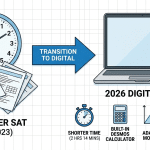
(Placeholder for Image: An infographic showing the key differences between the old paper SAT and the new Digital SAT.)
Meet Manny Spark: Your Partner in Academic Excellence
Preparing for an exam as pivotal as the SAT requires expert guidance. At Manny Spark, we are committed to empowering students like you to achieve their highest academic potential and secure admissions into their dream universities. We are not just a tutoring service; we are a dedicated educational consultancy built on the pillars of personalized attention, proven methodologies, and unwavering student support.
Our Physical Location and Learning Environment
For students who thrive in a structured, in-person learning setting, we welcome you to our state-of-the-art facility. The Manny Spark Educational Centre is specifically designed to minimize distractions and maximize focus, providing the perfect ambiance for rigorous academic work.
Our center is conveniently located at:
Manny Spark Educational Centre,
12, Adebayo Close, Off Adeniran Ogunsanya Street,
Surulere, Lagos, Nigeria.
This location is easily accessible from various parts of Lagos, ensuring that students can attend our classes with minimal transit stress. At this facility, we offer standard lecture rooms, a dedicated CBT (Computer-Based Testing) lab where you can practice the SAT in an environment that simulates the actual test day, and a library stocked with premium educational resources.
(Placeholder for Image: A welcoming photo of the entrance to the Manny Spark Educational Centre in Surulere.)
What Else We Offer
While SAT preparation is our flagship program, Manny Spark is a comprehensive educational hub. We understand that a student’s academic needs are multifaceted, especially when aiming for international education. Our other premium services include:
-
ACT Preparation: For students who prefer the ACT format, we provide equally rigorous and personalized coaching.
-
IGCSE & WAEC Tutoring: We offer specialized support for students preparing for their high school exit and college entry examinations.
-
University Admissions Consulting: From crafting compelling essays to optimizing your application profile, our experts guide you through the entire university application process for schools in the US, UK, Canada, and beyond.
-
CBT Practice Hub: Access our facility to practice various standardized tests under real exam conditions to build stamina and familiarity.
Our holistic approach ensures that once you walk through our doors or connect with us online, your academic journey is fully supported.
Understanding the Digital SAT Structure
Before we dive into the tips, it is essential to understand the layout of the exam you will be facing. The Digital SAT is two hours and 14 minutes long, a significant reduction from the three-hour paper version.
The test is composed of two primary sections, with a single 10-minute break in between. Here is a detailed breakdown of the 2026 SAT structure:
Table 1: Digital SAT Exam Structure
| Section | Number of Questions | Time Allotted | Question Types | Key Skills Tested |
| Reading & Writing | 54 Questions (divided into two 27-question adaptive modules) | 64 Minutes (32 minutes per module) | Four-choice Multiple Choice | Information and Ideas, Craft and Structure, Expression of Ideas, Standard English Conventions |
| Break | N/A | 10 Minutes | N/A | Restoration and Readiness |
| Math | 44 Questions (divided into two 22-question adaptive modules) | 70 Minutes (35 minutes per module) | Four-choice Multiple Choice, Student-Produced Responses (Grid-ins) | Algebra, Advanced Math, Problem-Solving and Data Analysis, Geometry and Trigonometry |
| Total | 98 Questions | 134 Minutes (2 hours 14 mins) |
Key Takeaway on Structure: The Reading & Writing section now presents students with much shorter passages—often just a single paragraph—with only one question attached to each. This is a dramatic shift from the long, multi-question passages of the past. The Math section allows the use of a calculator throughout, another major change.
10 Proven Tips for a High Score on the 2026 SAT
Now that you understand the new paradigm, let’s explore the ten strategies that will make the difference between an average score and a top-tier result. These are not shortcuts; they are scientifically proven methodologies that we at Manny Spark integrate into our coaching to help students excel.
Tip 1: Take an Official Diagnostic Test Early
You cannot map out a route if you don’t know your starting point. The very first step in your 2026 SAT prep should be to take a full-length, official Digital SAT practice test. Do not delay this. Many students make the mistake of studying for weeks before taking a test, only to realize they have been focusing on the wrong areas.
(Placeholder for Image: A student intently taking a practice SAT test on a laptop.)
Taking a diagnostic test under simulated exam conditions serves two purposes:
-
It Establishes Your Baseline: You get a realistic score that tells you exactly where you stand.
-
It Identifies Your Weaknesses: After the test, analyze your results. Are you struggling with geometry? Or is your issue “Standard English Conventions”? This data is the foundation of an effective study plan.
Our recommendation at Manny Spark is to use only official resources for this initial diagnostic to ensure the score is accurate. The best place to start is with the College Board’s Bluebook™ app.
Reach out to Manny Spark today to schedule a diagnostic session in our CBT lab, and our experts will provide you with a comprehensive analysis of your results to help you build a personalized study map.
Tip 2: Master the Bluebook™ Interface and Testing Tools
The medium is as important as the message. On the Digital SAT, your ability to navigate the digital interface efficiently is a skill in itself. The exam is administered through the Bluebook™ app, developed by the College Board. You must download this app onto the device you will use for the test well in advance.
(Placeholder for Image: A screenshot highlighting the various tools available within the Bluebook™ interface.)
The app contains built-in tools that are designed to help you, but they are only useful if you know how to use them instantly. These tools include:
-
Flag for Review: Allows you to mark questions you are unsure about and return to them easily.
-
Option Eliminator: A digital way to cross out answer choices you know are wrong.
-
The Built-in Graphing Calculator (Desmos): This is perhaps the most critical tool. It is a full version of the powerful Desmos calculator, which is available on all math sections.
-
The Mark-up Tool: Use it to highlight text in the reading passages.
-
Math Reference Sheet: Gives you access to common formulas.
“Give me six hours to chop down a tree and I will spend the first four sharpening the axe.” – Abraham Lincoln
Mastering these tools through repeated practice on the Bluebook app is “sharpening your axe.” It will save you precious seconds on test day and reduce anxiety. At Manny Spark, we have integrated Bluebook navigation into every prep class.
Tip 3: Create a Realistic, Data-Driven Study Plan
Consistency is the cornerstone of effective SAT prep. A cram session the night before the exam is utterly useless for the Digital SAT. Instead, you need a structured, consistent study schedule spanning 3 to 6 months.
Your study plan should be driven by the data from your diagnostic test. If you scored high in Reading but low in Math, your schedule should reflect a 3:1 ratio of Math to Reading study time.
We recommend breaking your study time into:
-
Concept Learning: Mastering the content (e.g., learning quadratic functions or subject-verb agreement rules).
-
Untimed Practice: Solving problems focused on that concept to ensure understanding.
-
Timed Practice: Taking timed sections to build speed.
-
Review: This is the most critical and often overlooked step—analyzing why you got questions wrong.
Table 2: Sample 12-Week SAT Study Timeline
| Timeline | Phase | Focus Areas | Study Volume |
| Week 1 | Diagnostic & Planning | Take Full Bluebook Practice Test 1; analyze strengths/weaknesses; set score goal; finalize study schedule. | 3 Hours |
| Weeks 2-4 | Content Foundation | Math: Focus on Algebra and Advanced Math core concepts. R&W: Master Standard English Conventions and craft/structure of short passages. | 6-8 Hours/Week |
| Weeks 5-6 | Skills Refinement | Math: Focus on Problem-Solving, Data Analysis, and Geometry/Trig. R&W: Enhance evidence-based reasoning in Information & Ideas. Begin timed section practice. | 8-10 Hours/Week |
| Week 7 | Checkpoint & Adjust | Take Full Practice Test 2. Analyze errors in depth. Adjust study plan based on new data. | 4 Hours (Test + 4 Hours Review) |
| Weeks 8-10 | Speed & Strategy | Intense timed section drills. Focus on weak sub-topics identified. Mastery of the Desmos calculator. | 10-12 Hours/Week |
| Week 11 | Simulation Phase | Take Full Practice Test 3 in CBT environment. Simulating real timing and conditions. Final comprehensive error review. | 8 Hours (Test + 6 Hours Review) |
| Week 12 | Final Polish & Rest | Light review of key formulas and rules. No new practice. Focus on physical rest, hydration, and mental preparation for test day. | 2-3 Hours |
Tip 4: Build Core Skills in the Reading and Writing Section
The Digital SAT combined the old Reading and Writing sections into one. The new section focuses more heavily on your ability to use command of evidence to analyze texts, determine vocabulary in context, and apply standard English conventions.
Short passages mean you cannot “skim” for the main idea. Every sentence matters. Your preparation must focus on:
-
Command of Evidence: Practice identifying which piece of textual evidence best supports a claim or the answer to a previous question.
-
Craft and Structure: Understand how authors build arguments, use rhetoric, and determine the meaning of complex vocabulary based on the surrounding context.
-
Expression of Ideas: These are grammar questions. You must know your rules—commas, semicolons, dashes, parallel structure, subject-verb agreement, and modifier placement are all non-negotiable.
(Placeholder for Image: A close-up of a student marking grammar rules in a study book.)
Italics text is often used on the SAT to highlight titles of works; pay attention to these clues. Internal link: For more detailed strategies on the Reading & Writing section, check out our exclusive guide on mastering digital SAT grammar rules.
Tip 5: Ace the Math Section with Concept Mastery and Desmos
The 2026 Math SAT tests four main domains (see Table 1). The most significant change is that calculators are allowed on all math modules. The built-in Desmos graphing calculator is a game-changer.
To succeed, you must:
-
Know your math concepts cold: A calculator is useless if you don’t know how to set up the problem. Master linear equations, quadratics, functions, and systems of equations. Advanced math topics like complex numbers and basic trigonometry are also tested.
-
Become a Desmos Wizard: You must know when to use Desmos and how to use it efficiently. Many complex problems involving systems of equations or inequalities can be solved in seconds by graphing them in Desmos and finding the intersection points.
At Manny Spark, we have a dedicated tutorial series on leveraging the Desmos calculator for the SAT. This is not about cheating the test; it is about using the official tools provided to their maximum advantage.
Tip 6: Develop Active Reading and Critical Analysis Techniques
Because you only have one question per short passage, you must engage with the text actively from the very first word. Passive reading is your enemy. As you read, mentally (or using the Bluebook highlight tool) note:
-
The Main Idea: What is the core point the author is making?
-
The Tone: Is the author neutral, analytical, persuasive, or critical?
-
The Evidence: What facts or examples does the author provide to support their point?
-
Key Transitions: Pay close attention to words like “however,” “therefore,” “in contrast,” and “moreover.” These signal shifts in argument or additional supporting points.
(Placeholder for Image: A student with a thoughtful expression, using their finger to trace a passage as they read actively.)
Practicing active reading with short, dense texts—such as those found in scientific journals, reputable news outlets, or official historical documents—will build the reading stamina and analytical precision needed for the SAT.
Tip 7: Practice Under Strict Time Constraints
Many students who know the content well fail to achieve their target score simply because they run out of time. The Digital SAT is not incredibly time-pressured, but it does require efficient pacing.
In the Reading & Writing section, you have approximately 71 seconds per question.
In the Math section, you have approximately 95 seconds per question.
This average includes easy questions you should answer in 20 seconds, allowing you to save time for complex multi-step math problems or difficult reading passages.
(Placeholder for Image: A timer countdown displaying 01:11, illustrating the time per question on the R&W section.)
To build this pacing, your study plan must include timed section practice. At Manny Spark, we administer weekly CBT mock tests under exact exam timing to help you build this rhythm.
Tip 8: Use High-Quality, Official Practice Materials
Not all practice materials are created equal. Since the Digital SAT format is still relatively new, some unofficial prep books may not perfectly capture the adaptive nature or question style of the actual exam. Using low-quality materials can give you a false sense of security or focus your efforts on topics not tested.
Your preparation hierarchy should be:
-
Top Tier: The 4 Full-Length Official Practice Tests in the Bluebook app. This is the gold standard.
-
Second Tier: The Official SAT Practice Question Bank on the College Board website (accessible via your student account).
-
Third Tier: Official SAT Prep on Khan Academy, which is directly aligned with the Digital SAT.
-
Fourth Tier: Prep from established, reputable prep centers like Manny Spark, which use updated curriculums.
Tip 9: Maintain a Rigorous Error Log
If you are only taking practice tests and not analyzing your mistakes, you are wasting your time. You cannot improve what you do not measure. After every timed section or practice test, you must create a detailed entry in your Error Log for every question you got wrong or guessed on.
A complete error log entry includes:
-
Question ID: Which test and which number?
-
Domain & Skill: E.g., Math, Advanced Math, Quadratic Equations.
-
Reason for Error: This is the most crucial column. Be honest. Was it a careless mistake (misreading, miscalculation)? A conceptual gap (you didn’t know the topic)? Or a timing issue (you were rushed)?
-
The Fix: What will you do differently next time? “Review the rules for semicolons.” “Practice graphing functions in Desmos.”
At Manny Spark, reviewing your error log with a tutor is a central part of our personalized coaching. We don’t just teach you the content; we teach you how to analyze your own learning to prevent repeat mistakes.
Tip 10: Optimize Your Physical and Mental Well-being
The SAT is as much a test of endurance and focus as it is of academic skill. Your brain is a muscle, and it requires proper care. You cannot perform at your peak if you are sleep-deprived, dehydrated, or burnt out.
-
Prioritize Sleep: In the week leading up to the test, and especially on the two nights before, aim for 8-9 hours of quality sleep.
-
Hydrate: Water is essential for cognitive function. Hydration should be part of your test prep.
-
Eat well: On the morning of the test, eat a balanced, nutritious breakfast that provides long-lasting energy. Avoid sugary cereals that will cause a crash later.
-
Manage Stress: Build meditation or relaxation techniques into your daily routine. If you feel panicky during the test, take 10 seconds for deep breathing exercises.
(Placeholder for Image: A student sleeping peacefully, with a book on their bedside table, emphasizing the importance of rest.)
Key Takeaway on Physical Health: Your performance on test day is a holistic result of your studies, your strategies, and your physical state.
Manny Spark’s Comprehensive Educational Services
Success on the SAT in 2026 is entirely within your reach. With the right strategies, a consistent study plan, and expert guidance, you can achieve a score that opens the doors to your academic future.
At Manny Spark, we have designed our services to be the catalyst for your success. Our comprehensive approach combines top-tier in-person and online instruction with a supportive environment focused on results.
When you enroll in a Manny Spark prep program, you are not just getting a tutor; you are gaining:
-
A personalized curriculum tailored to your specific diagnostic results.
-
Weekly CBT mock exams to simulate test day.
-
Expert analysis of your error log with a dedicated coach.
-
In-depth tutorials on mastering tools like the Desmos calculator.
-
University admissions consulting to ensure your high score is leveraged for maximum impact.
(Placeholder for Image: A joyful student and their parent celebrating a high score result outside the Manny Spark centre.)
Don’t leave your academic future to chance. The path to a 1500+ score starts with your very first decision: to prepare effectively. We recommend that you connect with us as early as possible in your SAT journey.
How to Reach Us
Our educational experts are ready to answer your questions and help you schedule your first diagnostic test. While we are available on various platforms, we recommend you mail us for the fastest response.
Email: info@mannyspark.com (Highly Recommended for Fast Response)
Call: 07062720516
Whatsapp: 08039822082
Telegram: @DocManny
Key Takeaway: Consistency is the Key to SAT Success
The 2026 Digital SAT may feel daunting, but it is just a test of standardized skills. While the format is adaptive, your preparation must be consistent. There are no shortcuts. You cannot cram for this test.
Success is built one day at a time, one practice session at a time, and one error analysis at a time. Establish your baseline, master the tools, learn your concepts, review your mistakes rigorously, and most importantly, maintain your physical and mental energy. This disciplined approach is the differentiator.
Remember, your score on the SAT is not a measure of your intelligence; it is a measure of how well you have prepared for the exam itself. With the proven tips provided in this guide and the expert support of Manny Spark, you can walk into that test center with confidence and walk out with a score that unlocks your dream future.
Your journey starts now. We are here to guide you every step of the way.
 Message Dr. MANNY on WhatsApp
QUICK TRANSFERS, Pay into this Account:
1481900827 | ACCESS BANK | EMMANUEL OLUWASEUN OTOBOR
Once your payment is successful kindly send the “PAST QUESTION” you need, your “ACCOUNT NAME” and “EMAIL ADDRESS” to 08039822082. or info@mannyspark.com
