
QUICK TRANSFERS, Pay into this Account:
1481900827 | ACCESS BANK | EMMANUEL OLUWASEUN OTOBOR
Once your payment is successful kindly send the “PAST QUESTION” you need, your “ACCOUNT NAME” and “EMAIL ADDRESS” to 08039822082. or info@mannyspark.com


Join Free WAEC 2026 WhatsApp Group Link for Nigerian Students
The West African Examinations Council (WAEC) examination, known as the West African Senior School Certificate Examination (WASSCE), is a defining moment for Nigerian students. It’s a gateway to higher education, scholarships, and career opportunities in a country where academic excellence can significantly impact one’s future. With over 1.5 million candidates registering annually across Nigeria’s 36 states and the Federal Capital Territory (FCT), the stakes are high. At Manny Spark, led by Dr. Manny, we are dedicated to empowering Nigerian students with accessible, high-quality resources to excel in WAEC 2026.
This article provides a comprehensive guide to preparing for WAEC 2026, spotlighting our free WhatsApp group designed for Nigerian students. Whether you’re studying in the vibrant streets of Lagos, the administrative hub of Abuja, the historic city of Kano, or the oil-rich Port Harcourt, our group connects you with peers, expert advice, and study materials tailored to Nigeria’s educational landscape. From exam structure to registration, syllabus details, study strategies, and more, this 3,000+ word guide, written in an educational tone, ensures you’re well-equipped for success.
“Education is the passport to the future, for tomorrow belongs to those who prepare for it today,” said Malcolm X, a quote that resonates deeply with Nigeria’s youth striving for academic excellence. At Manny Spark, we embody this vision by offering innovative learning solutions. For personalized support, reach out to me, Dr. Manny, at 08039822082 or 09051720414.

Join Free WAEC 2026 WhatsApp Group Link for Nigerian Students
Understanding WAEC and Its Significance in Nigeria
The West African Examinations Council, established in 1952, is a regional examination body overseeing standardized testing in Nigeria, Ghana, Sierra Leone, Liberia, and The Gambia. In Nigeria, the WASSCE is the culmination of secondary education, taken by students in Senior Secondary 3 (SS3). It assesses proficiency in core and elective subjects, serving as a prerequisite for university admission through the Unified Tertiary Matriculation Examination (UTME) or direct entry programs.
Why is WAEC so critical in Nigeria? The exam is a cornerstone of the educational system, influencing access to higher education and employment. According to the Nigerian Bureau of Statistics, students with strong WAEC results are 40% more likely to secure scholarships or gain admission into prestigious institutions like the University of Lagos, Ahmadu Bello University, or Obafemi Awolowo University. In a country of over 200 million people, where education drives social mobility, WAEC is a make-or-break milestone.
Across Nigeria’s diverse regions, WAEC’s impact varies but remains profound. In Lagos State, with its population exceeding 20 million and numerous secondary schools in areas like Ikeja, Surulere, and Lekki, WAEC preparation is highly competitive. In Kano, a northern hub with a rich cultural heritage, the exam is a stepping stone for students aiming to bridge educational gaps. In Port Harcourt, Rivers State, known for its oil industry, WAEC success opens doors to technical and academic careers. Similarly, in Abuja, the FCT, students leverage WAEC for federal opportunities. Manny Spark tailors its resources to address these regional nuances, ensuring inclusivity.
“An investment in knowledge pays the best interest,” Benjamin Franklin once said, a principle that drives Manny Spark’s mission to empower students nationwide. For more insights on WAEC’s role in Nigeria, explore our internal guide on WAEC’s Impact on Nigerian Education.
Overview of the WAEC 2026 Examination
WAEC 2026 is set to introduce a hybrid examination format, blending traditional pen-and-paper tests with computer-based testing (CBT) for select subjects like Mathematics and English Language objectives. This modernization, announced by WAEC officials, aims to enhance efficiency and curb examination malpractices. Based on the 2025 schedule (April 24 to June 20), WAEC 2026 is expected to run from late April to mid-June 2026, spanning approximately eight weeks.
Key Features of WAEC 2026:
- Examination Period: Covers theory, objective, and practical papers.
- Locations: Conducted in accredited centers across Nigeria’s 36 states and the FCT. In Lagos, centers are in areas like Yaba and Agege; in Abuja, venues include schools in Garki and Maitama; in Kano, centers are in Sabon Gari; and in Port Harcourt, locations span Diobu and Trans-Amadi.
- Accessibility: WAEC provides accommodations like braille papers, extra time for students with disabilities, and result verification for international use.
- Innovations: CBT for objective papers in urban centers like Lagos and Abuja, with traditional formats retained in rural areas like Borno or Cross River.
Here’s a projected timetable based on historical data (subject to official confirmation):
| Date | Subject | Paper Type | Time |
|---|---|---|---|
| April 28, 2026 | Foods and Nutrition | Practical | 9:00 AM – 12:00 PM |
| May 5, 2026 | English Language | Essay & Objective (CBT in select centers) | 9:00 AM – 12:30 PM |
| May 12, 2026 | Mathematics | Theory & Objective (CBT option) | 9:00 AM – 1:30 PM |
| June 2, 2026 | Physics | Practical | 2:00 PM – 5:00 PM |
| June 15, 2026 | Biology | Theory & Objective | 9:00 AM – 11:30 AM |
For the latest updates, visit the WAEC Nigeria website.
This hybrid approach ensures fairness while adapting to Nigeria’s growing digital infrastructure. Manny Spark’s WhatsApp group will provide real-time updates on these changes.
WAEC 2026 Registration Process in Nigeria
Registering for WAEC 2026 is a critical step that requires careful planning. The process is managed through schools for regular candidates and private centers for external candidates, with an online component for biometrics.
Step-by-Step Registration Process:
- School Recognition and CASS Upload: Schools must be WAEC-accredited and upload Continuous Assessment Scores (CASS) from August 19, 2025, to October 31, 2025.
- Offline Registration: Begins around September 2025, involving fingerprint capture and candidate details.
- Online Registration: Completed by early 2026 via the WAEC portal, with a fee of approximately ₦18,000 (subject to change).
- Requirements: Birth certificate, two passport photographs, and school endorsement.
- Private Candidates: Register directly on the WAEC portal, ideal for students in remote areas like Calabar or Sokoto.
Regional Considerations: In urban hubs like Lagos, registration centers are plentiful, but in rural areas like Kebbi or Taraba, access may be limited. Manny Spark offers guidance in our WhatsApp group to navigate these challenges. Contact Dr. Manny at 08039822082 for assistance.
“Proper preparation prevents poor performance,” a common adage among WAEC examiners, underscores the importance of timely registration.
For official details, check the WAEC Registration Portal.
[Insert Image Here: Infographic illustrating the WAEC registration process]
Core Subjects and Syllabus Breakdown for WAEC 2026
WAEC requires candidates to register for 8-9 subjects, including core subjects (English, Mathematics, Civic Education) and electives based on their academic stream (science, arts, or commercial). The 2025/2026 syllabus emphasizes practical, Nigeria-relevant content.
Core Subjects and Key Topics:
- English Language: Comprehension, summary writing, essay composition, grammar, and oral skills. Focus areas include Nigerian literature and vocabulary.
- Mathematics: Algebra, geometry, trigonometry, statistics, and basic calculus. Emphasis on real-world applications like budgeting in Nigeria’s economy.
- Civic Education: Democracy, human rights, Nigerian constitution, and civic responsibilities.
Elective Examples:
- Biology: Cell biology, ecology, genetics, and human physiology.
- Physics: Mechanics, optics, electricity, and thermodynamics.
- Economics: Demand and supply, fiscal policy, and Nigeria’s economic structure.
Here’s a detailed breakdown of core subjects:
| Subject | Key Topics | Assessment Weight | Study Tips |
|---|---|---|---|
| English Language | Comprehension, essay, oral English | Essay (50%), Objective (30%), Oral (20%) | Read Nigerian newspapers, practice essays on social issues |
| Mathematics | Number bases, sets, quadratic equations | Theory (50%), Objective (50%) | Solve 10 problems daily, focus on weak areas |
| Civic Education | Rule of law, citizenship, governance | Objective (40%), Theory (60%) | Memorize key constitutional terms |
| Biology | Photosynthesis, ecosystems, genetics | Practical (35%), Theory (65%) | Practice diagrams for practicals |
| Chemistry | Atomic structure, organic chemistry | Practical (35%), Theory (65%) | Master chemical equations |
The syllabus is accessible on the WAEC e-Learning Portal. At Manny Spark, we provide syllabus summaries in our WhatsApp group to simplify preparation.
[Insert Image Here: Chart showing WAEC subject combinations for science, arts, and commercial streams]
Why Join a WhatsApp Study Group for WAEC Preparation?
Collaborative learning via platforms like WhatsApp has transformed exam preparation globally. In Nigeria, where over 150 million people have internet access, WhatsApp groups are a game-changer for students, especially in areas with limited access to physical tutoring centers.
Benefits of WhatsApp Study Groups:
- Instant Peer Support: Connect with students from cities like Enugu or rural areas like Yobe to share doubts and solutions.
- Resource Sharing: Access past questions, notes, and video tutorials instantly.
- Motivation and Accountability: Daily check-ins and group challenges keep you on track.
- Accessibility: Study on-the-go, crucial in traffic-heavy cities like Lagos or during power outages in places like Benin City.
- Cost-Effective: Free groups like ours at Manny Spark eliminate financial barriers.
A 2023 study on collaborative learning found that students in study groups scored 15% higher on average due to interactive discussions <grok:render type=”render_inline_citation”>1. However, distractions like off-topic chats can occur, which is why Manny Spark employs moderators to maintain focus.
“Coming together is a beginning; keeping together is progress; working together is success,” Henry Ford’s words highlight the power of community learning.
Manny Spark’s Free WAEC 2026 WhatsApp Group
At Manny Spark, we’ve created a free WAEC 2026 WhatsApp group to support Nigerian students nationwide. Led by Dr. Manny, an experienced educational consultant, this group offers:
- Daily Study Tips: Bite-sized advice on tackling tough topics like organic chemistry or essay writing.
- Past Questions and Solutions: Shared weekly, covering 1993–2025 papers.
- Live Q&A Sessions: Bi-weekly discussions with Dr. Manny and guest tutors.
- Motivational Content: Quotes and success stories to keep you inspired.
- Regional Focus: Tailored advice for students in urban centers like Ibadan or rural areas like Bauchi.
The group is accessible to students across Nigeria’s diverse regions, from the coastal Niger Delta to the northern Sahel. To join, click the WAEC 2026 WhatsApp Group Link or contact Dr. Manny at 08039822082 or 09051720414.
“Alone, we can do so little; together, we can do so much,” Helen Keller’s words inspire our community-driven approach at Manny Spark.
Proven Study Strategies for WAEC 2026 Success
Effective preparation is the key to acing WAEC 2026. Here are proven strategies tailored for Nigerian students, based on insights from top performers and educators.
General Strategies:
- Create a Study Timetable: Allocate 2–3 hours daily per subject. For example, dedicate Mondays to Mathematics and Tuesdays to English.
- Start Early: Begin revision by November 2025 to cover the syllabus comprehensively.
- Active Learning Techniques: Summarize notes, teach peers, or use flashcards for memorization.
- Incorporate Breaks: Study for 50 minutes, then take a 10-minute break to avoid burnout.
Subject-Specific Tips:
- English Language: Practice essays on Nigeria-relevant topics like “The Role of Youth in Nation-Building.” Read newspapers like The Punch to enhance vocabulary.
- Mathematics: Solve at least 10 problems daily, focusing on areas like trigonometry or probability. Use calculators approved by WAEC.
- Science Practicals: Familiarize yourself with lab equipment and procedures, crucial for exams in centers like Owerri or Kaduna.
Additional Tips:
- Group Study: Join our Manny Spark WhatsApp group for collaborative learning.
- Mock Exams: Simulate exam conditions to build stamina.
- Health Management: Get 7–8 hours of sleep, especially important in Nigeria’s demanding climate.
A 2024 survey of WAEC candidates revealed that students with structured study plans scored 20% higher than those without <grok:render type=”render_inline_citation”>25.
“Success doesn’t come from what you do occasionally, but from what you do consistently,” Marie Forleo’s quote underscores the need for daily effort.
For advanced techniques, check our internal guide Study Hacks for WAEC Success.
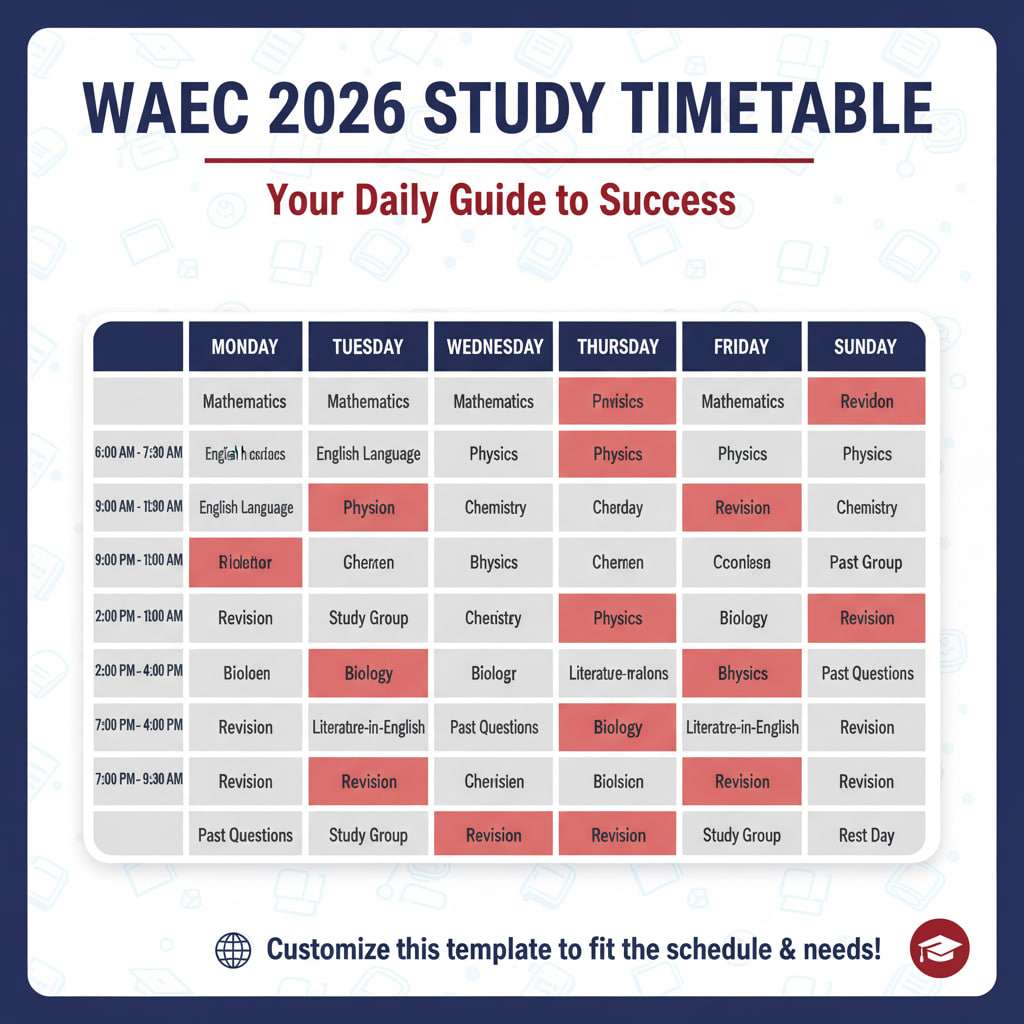
Join Free WAEC 2026 WhatsApp Group Link for Nigerian Students
Maximizing Past Questions and Answers for Practice
Past questions are a cornerstone of WAEC preparation, as the exam often repeats question patterns. Practicing them builds familiarity and confidence.
How to Use Past Questions Effectively:
- Source Reliable Materials: Download from trusted platforms like MyschoolGist or the WAEC e-Learning Portal.
- Timed Practice: Set a timer to mimic exam conditions (e.g., 2 hours for Mathematics theory).
- Review Answers: Analyze mistakes to understand concepts.
- Focus on Trends: Note recurring topics, like quadratic equations in Mathematics or ecosystem questions in Biology.
Manny Spark shares solved past papers from 1993 to 2025 in our WhatsApp group, covering subjects like Physics, Chemistry, and Economics. For example, a 2023 Mathematics question on simultaneous equations mirrored a 2018 paper, highlighting the value of historical practice.
[Insert Image Here: Stack of WAEC past question booklets]
Additional Resources and Tools from Manny Spark
Beyond our WhatsApp group, Manny Spark offers a suite of resources tailored for Nigerian students:
- E-Books: Comprehensive guides on WAEC strategies, available in the group.
- Webinars: Monthly sessions on time management and exam anxiety, hosted by Dr. Manny.
- Personalized Tutoring: One-on-one consultations via call (08039822082 or 09051720414).
- Study Planners: Customizable templates to organize your revision.
These resources address Nigeria-specific challenges, such as power outages in cities like Jos or limited internet in rural Adamawa. We also recommend external tools like uLesson for interactive video lessons and PrepUp for mock tests <grok:render type=”render_inline_citation”>30.
[Insert Image Here: Collage of Manny Spark resources, including e-books and webinar screenshots]
Explore more at Manny Spark’s Resource Hub.
Addressing Common Challenges in WAEC Preparation
Nigerian students face unique challenges in WAEC preparation, from infrastructure issues to financial constraints. Here’s how to overcome them:
Challenge 1: Limited Access to Resources
- Solution: Join our Manny Spark WhatsApp group for free materials. Use offline resources like printed past questions, available in markets in Onitsha or Aba.
Challenge 2: Exam Anxiety
- Solution: Practice mindfulness techniques, shared in our group. Simulate exams to build confidence.
Challenge 3: Time Management
- Solution: Follow a structured timetable. Our group offers daily reminders to stay on track.
Challenge 4: Regional Disparities
- In rural areas like Gombe or Ekiti, access to tutors is limited. Our WhatsApp group connects you with experts and peers nationwide.
A 2024 study highlighted that 25% of Nigerian students cited anxiety as a major barrier <grok:render type=”render_inline_citation”>42. Manny Spark addresses this with motivational content and expert support.
“The greatest glory in living lies not in never falling, but in rising every time we fall,” Nelson Mandela’s words inspire resilience in preparation.
For more on overcoming obstacles, read our internal post Tackling WAEC Challenges in Nigeria.
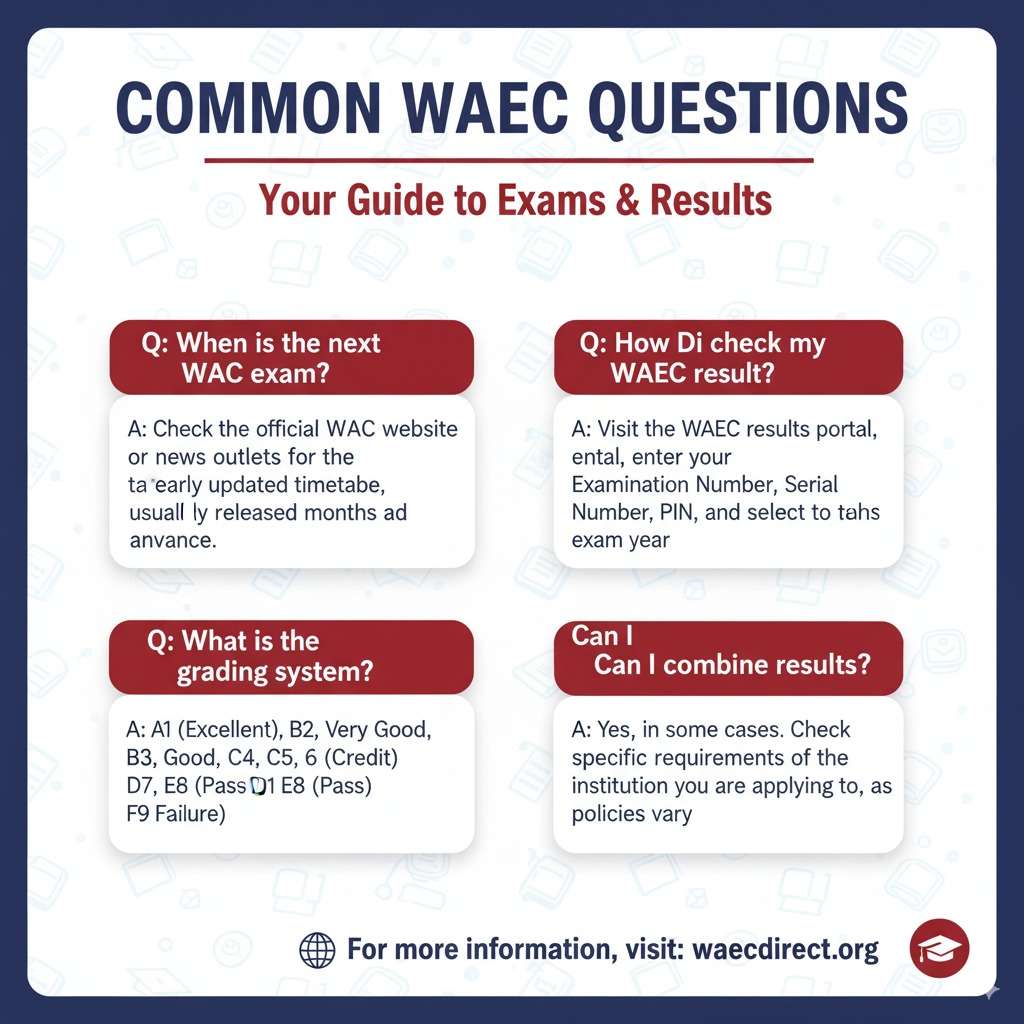
Frequently Asked Questions About WAEC 2026
Q: When will WAEC 2026 start?
A: Likely late April 2026, with a hybrid format. Check the WAEC Nigeria website for updates.
Q: How can I check my WAEC results?
A: Via the WAEC portal in August 2026, using your exam number and PIN.
Q: What happens if I miss the registration deadline?
A: Late registration incurs extra fees. Contact your school or Dr. Manny at 09051720414 for guidance.
Q: Are CBT exams mandatory?
A: No, CBT is optional for select subjects in urban centers. Traditional papers remain available.
For more FAQs, visit WAEC Nigeria FAQ.
[Insert Image Here: FAQ infographic with common WAEC questions]
Key Takeaways
- Understand the Exam: WAEC 2026 introduces a hybrid format, requiring familiarity with both paper and CBT.
- Register on Time: Follow deadlines (September 2025–early 2026) to avoid penalties.
- Join Our Community: Manny Spark’s free WhatsApp group offers peer support, past questions, and expert tips.
- Practice Strategically: Use past questions to master recurring topics.
- Leverage Resources: Access Manny Spark’s e-books, webinars, and tutoring for tailored support.
- Stay Resilient: Overcome challenges with structured planning and community encouragement.
 Message Dr. MANNY on WhatsApp
QUICK TRANSFERS, Pay into this Account:
1481900827 | ACCESS BANK | EMMANUEL OLUWASEUN OTOBOR
Once your payment is successful kindly send the “PAST QUESTION” you need, your “ACCOUNT NAME” and “EMAIL ADDRESS” to 08039822082. or info@mannyspark.com
