Ultimate Guide to the Paul Alaje Colloquium TPAC National Essay Competition 2026

QUICK TRANSFERS, Pay into this Account:
1481900827 | ACCESS BANK | EMMANUEL OLUWASEUN OTOBOR
Once your payment is successful kindly send the “PAST QUESTION” you need, your “ACCOUNT NAME” and “EMAIL ADDRESS” to 08039822082. or info@mannyspark.com


Ultimate Guide to the Paul Alaje Colloquium TPAC National Essay Competition 2026
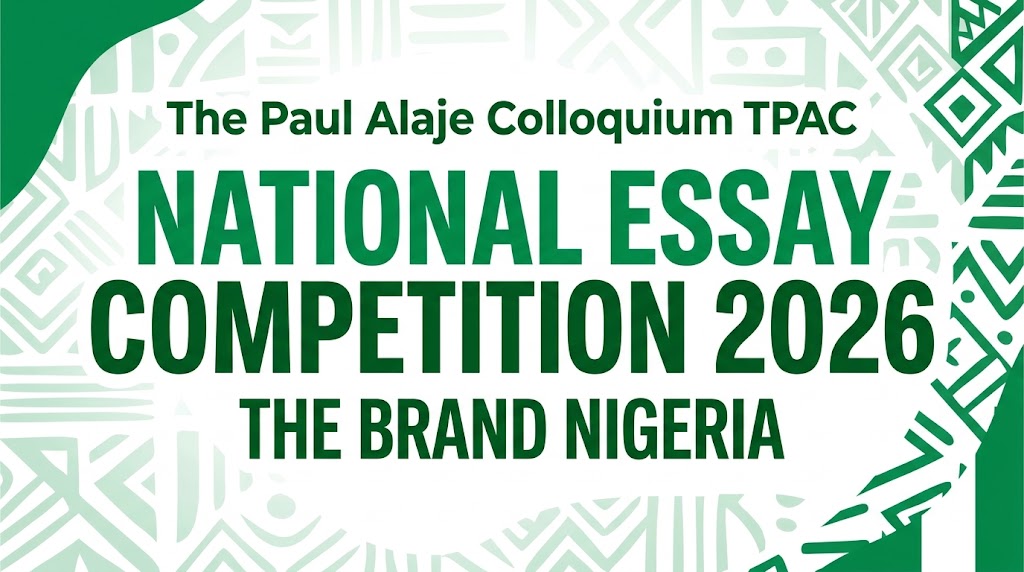
The Paul Alaje Colloquium (TPAC) National Essay Competition 2026 is now officially open for entries, presenting a premier intellectual platform for students across Nigeria. Designed to foster rigorous critical thinking, policy-driven discourse, and creative problem-solving, this prestigious nationwide academic contest invites young minds to contribute actionable ideas toward national development, socioeconomic transformation, and global positioning.
Centered around the timely and strategic theme, “The Brand Nigeria,” the competition challenges participants to examine how key drivers—specifically education, entrepreneurship, technology, and creativity—can be systematically harnessed to elevate Nigeria’s global image and unleash its immense domestic potential. By analyzing the intersection of policy, innovation, and human capital, essayists are encouraged to offer clear, well-researched blueprints that address real-world governance, economic growth, and societal advancement.
With substantial cash awards designated for secondary school, undergraduate, and postgraduate students, the TPAC National Essay Competition serves as both a financial springboard and a major academic milestone. For aspiring scholars, policy analysts, and youth advocates across Nigeria, participating in this contest provides an invaluable opportunity to showcase research competence, refine intellectual voice, and influence the ongoing dialogue regarding the nation’s future trajectory.
Scholarship Overview
Ultimate Guide to the Paul Alaje Colloquium TPAC National Essay Competition 2026
The table below highlights the core specifications of the Paul Alaje Colloquium National Essay Competition 2026 for quick reference:
| Field | Details |
| Scholarship Name | Paul Alaje Colloquium (TPAC) National Essay Competition |
| Scholarship Provider | Paul Alaje Colloquium (TPAC) Initiative |
| Study Level | Secondary School, Undergraduate, Postgraduate |
| Funding Type | Financial Cash Grant / Academic Award |
| Eligible Countries | Nigeria |
| Host Country | Nigeria |
| Scholarship Value | Up to ₦1,000,000 across multiple categories |
| Application Deadline | October 26, 2026 |
| Application Status | Currently Open |
About the Scholarship

Ultimate Guide to the Paul Alaje Colloquium TPAC National Essay Competition 2026
The Paul Alaje Colloquium (TPAC) is a prominent educational and public policy platform created to stimulate intellectual engagement, research excellence, and sustainable development initiatives across Nigeria. Named after renowned economist and policy expert Paul Alaje, the colloquium brings together thought leaders, policymakers, academic researchers, and student innovators to debate, analyze, and propose practical solutions to Nigeria’s complex socioeconomic realities.
Through its annual National Essay Competition, TPAC aims to bridge the gap between academic theory and practical policy execution. The competition encourages students to move beyond passive observation and actively participate in civic discourse. By empowering the next generation of thinkers, TPAC fosters a culture of empirical analysis, structured debate, and visionary leadership.
Understanding the 2026 Theme: “The Brand Nigeria”

Ultimate Guide to the Paul Alaje Colloquium TPAC National Essay Competition 2026
For the 2026 edition, candidates are required to explore the overarching theme “The Brand Nigeria.” Nation branding is far more than a public relations campaign; it reflects a country’s economic stability, institutional integrity, cultural output, technological adoption, and human capital quality.
Participants are urged to analyze how structural reforms in four core pillars can redefine Nigeria’s global standing:
-
Education: Revamping curriculum design, funding technical research, improving infrastructure, and closing the gap between tertiary institutions and labor market demands.
-
Entrepreneurship: Cultivating a supportive ecosystem for small and medium-sized enterprises (SMEs), expanding access to seed funding, reducing bureaucratic bottlenecks, and enabling youth enterprise.
-
Technology: Leveraging digital infrastructure, artificial intelligence, financial technology (Fintech), and software engineering to drive financial inclusion, governance efficiency, and global export of technological solutions.
-
Creativity: Harnessing Nigeria’s vibrant creative economy—including Nollywood, Afrobeats, visual arts, fashion, and digital content creation—as soft power tools for cultural diplomacy and international revenue generation.
Detailed Breakdown of Scholarship Benefits
The Paul Alaje Colloquium National Essay Competition offers significant financial rewards designed to alleviate academic costs, support ongoing studies, and encourage intellectual dedication among Nigerian youths.
Cash Prizes by Academic Category
-
Postgraduate Category Winner: Receives a cash prize of ₦1,000,000. This award provides financial support for postgraduate research, thesis publishing, academic tuition, or specialized professional training.
-
Undergraduate Category Winner: Awarded a cash prize of ₦750,000. These funds help cover university tuition, textbooks, accommodation costs, research projects, and personal academic maintenance.
-
Secondary School Category Winner: Awarded a cash prize of ₦500,000. This grant supports secondary education expenses, senior school certificate examination (SSCE) fees, and transition preparation for higher learning institutions.
Additional Value and Intellectual Benefits
-
National Exposure: Winning essayists gain recognition across national media platforms and academic circles.
-
Policy Engagement: Top entries may be published in official TPAC policy briefs, offering student authors a platform to present their ideas directly to public administrators, industry leaders, and academic stakeholders.
-
Mentorship & Networking: Finalists gain access to the TPAC network, opening doors to mentorship opportunities, career guidance, and future academic collaborations.
Eligibility Requirements

Ultimate Guide to the Paul Alaje Colloquium TPAC National Essay Competition 2026
To ensure a fair and competitive selection process, candidates must satisfy all eligibility criteria established by the TPAC screening committee:
-
Nationality and Residency: Applicants must be citizens of the Federal Republic of Nigeria currently residing and studying within the country.
-
Secondary School Category: Open to students currently enrolled in accredited secondary schools (Junior Secondary or Senior Secondary) across any state in Nigeria.
-
Undergraduate Category: Open to students registered in recognized tertiary institutions, including state/federal universities, polytechnics, and colleges of education.
-
Postgraduate Category: Open to students enrolled in accredited postgraduate programs (Postgraduate Diploma, Master’s degree, or Doctorate / Ph.D. level) in Nigeria.
-
Academic Standing: Candidates must be actively enrolled during the 2026 academic calendar.
-
Originality Mandate: All entries must be completely original, unpublished works created solely by the submitting student. Co-authored essays, previously published articles, or plagiarized materials are strictly disqualified.
Required Documents and Submission Guidelines

Ultimate Guide to the Paul Alaje Colloquium TPAC National Essay Competition 2026
Adherence to technical and formatting instructions is a crucial component of the evaluation process. Submissions that fail to meet specifications risk immediate administrative rejection.
Technical Formatting Specifications
-
Accepted File Format: Entries must be uploaded strictly in PDF (.pdf) format. Word documents (.doc/.docx), text files, or image uploads will not be accepted.
-
Word Count Requirements:
-
Undergraduate & Postgraduate Categories: Essays must be strictly between 2,500 and 3,000 words (excluding the cover page and bibliography/references).
-
Secondary School Category: Candidates must follow the specific word count range provided on the official portal for secondary submissions.
-
-
Font and Typography: Use standard, professional fonts (such as Times New Roman, Arial, or Calibri) at 12-point size with 1.5 line spacing and standard 1-inch margins.
Mandatory Cover Page Setup
Every submission must include a standalone title cover page as the first page of the PDF document containing the following verified details:
-
Full Name (Last Name, First Name, Middle Name)
-
Name of Educational Institution
-
Current Department, Faculty, and Level of Study
-
Active Mobile Phone Number
-
Primary Email Address
-
Target Category (Secondary, Undergraduate, or Postgraduate)
-
Title of the Essay
Available Categories

Ultimate Guide to the Paul Alaje Colloquium TPAC National Essay Competition 2026
The table below outlines the category specifications, eligible applicant profiles, word count parameters, and corresponding cash rewards:
| Category Name | Target Academic Level | Mandatory Word Count | Cash Award |
| Postgraduate Category | Master’s, PGD, and Ph.D. candidates | 2,500 – 3,000 words | ₦1,000,000 |
| Undergraduate Category | University, Polytechnic, and College students | 2,500 – 3,000 words | ₦750,000 |
| Secondary School Category | Junior & Senior Secondary School students | Specified on portal | ₦500,000 |
How to Apply

Ultimate Guide to the Paul Alaje Colloquium TPAC National Essay Competition 2026
Applying for the TPAC National Essay Competition 2026 requires careful preparation and adherence to the official online submission process. Follow these step-by-step instructions to ensure a seamless application:
-
Visit the Official Application Portal: Access the competition web page by navigating directly to the TPAC submission URL.
-
Review Official Guidelines: Select your respective academic category and thoroughly read the official guidelines, theme interpretations, and technical instructions.
-
Conduct In-Depth Research: Collect relevant data, official economic indicators, academic literature, and case studies surrounding “The Brand Nigeria.”
-
Draft and Structure Your Essay: Write a coherent essay addressing education, entrepreneurship, technology, and creativity. Ensure your narrative flows logically and falls precisely within the stipulated word count.
-
Format Your Cover Page: Create a standardized cover page containing all mandatory personal and institutional details.
-
Convert and Save as PDF: Export or print your completed draft into a clean PDF document. Double-check that all formatting, citations, and headers remain intact.
-
Submit Online Before the Deadline: Go to the “National Essay Competition 2026” section on the portal, click “Submit Essay Online,” complete the required demographic form, upload your PDF file, and confirm final submission.
Selection Process and Evaluation Criteria

Ultimate Guide to the Paul Alaje Colloquium TPAC National Essay Competition 2026
Entries submitted to the Paul Alaje Colloquium National Essay Competition 2026 undergo a rigorous, multi-tier evaluation process by an independent panel of academics, policy experts, and professional editors.
Assessment Breakdown
-
Relevance to Theme (25%): How well the essay interprets “The Brand Nigeria” and explores the interconnected roles of education, entrepreneurship, technology, and creativity.
-
Depth of Research and Evidence (25%): Quality of data, empirical research, official statistics, and contextual examples used to back policy recommendations.
-
Originality and Critical Thinking (20%): Innovative thinking, fresh perspectives, and pragmatic policy solutions rather than generic commentary.
-
Structure and Logical Flow (15%): Clear organization featuring a strong thesis statement, cohesive paragraph structure, balanced argumentation, and a sound conclusion.
-
Grammar, Style, and Formatting (15%): Flawless language usage, adherence to word count constraints, correct PDF formatting, proper cover page inclusion, and accurate citations.
Important Dates

Ultimate Guide to the Paul Alaje Colloquium TPAC National Essay Competition 2026
Applicants must manage their timelines effectively to ensure all requirements are met prior to portal closure:
| Stage / Milestone | Date |
| Official Application Window | Currently Open |
| Submission Deadline | October 26, 2026 |
| Evaluation Period | To be announced on portal |
| Winners Announcement | To be communicated via official channels |
In-Depth Guide to Writing a Winning Essay
Ultimate Guide to the Paul Alaje Colloquium TPAC National Essay Competition 2026
To stand out among thousands of entries across Nigeria, applicants should adopt an academic and analytical writing approach. Below are detailed strategy points designed to elevate your essay submission:
1. Formulate a Strong Thesis Statement
Avoid vague summaries of Nigeria’s problems. Instead, frame a clear, solution-oriented thesis statement in your introduction. Clearly assert how strategic investments in technology or educational reform directly reposition the national brand globally.
2. Balance the Four Pillars
Ensure your essay addresses all core components of the prompt—education, technology, entrepreneurship, and creativity. Show how these elements interact. For instance, illustrate how tech-driven education fuels entrepreneurial ventures in the creative sector.
3. Use Data and Real-World Evidence
Strengthen your arguments with verified data from reliable sources such as the National Bureau of Statistics (NBS), Central Bank of Nigeria (CBN), World Bank, or UNESCO. Citing exact figures regarding youth employment, digital penetration, or creative sector GDP contributions adds significant authority to your paper.
4. Provide Realistic Policy Recommendations
Assessors look for actionable solutions. Instead of general assertions like “government should fix infrastructure,” propose specific policy frameworks, public-private partnership (PPP) models, or community-driven programs that can realistically be implemented.
5. Rigorous Proofreading and Formatting
Eliminate grammatical errors, awkward phrasing, and typographical mistakes. Ensure your references follow a consistent citation format (such as APA or Harvard style). Always verify that your word count strictly respects the 2,500 – 3,000 range for tertiary entries before generating your final PDF.
Frequently Asked Questions

Ultimate Guide to the Paul Alaje Colloquium TPAC National Essay Competition 2026
1. Who is eligible to participate in the TPAC National Essay Competition 2026?
The contest is open to secondary school, undergraduate, and postgraduate students enrolled in recognized educational institutions in Nigeria.
2. Is there any registration or entry fee?
No, participation in the Paul Alaje Colloquium National Essay Competition is completely free of charge.
3. What is the central topic for the 2026 competition?
The theme is “The Brand Nigeria,” focusing on how education, entrepreneurship, technology, and creativity can transform national potential into international prestige.
4. What are the cash prizes for each category?
The postgraduate category winner receives ₦1,000,000; the undergraduate category winner receives ₦750,000; and the secondary school category winner receives ₦500,000.
5. What file format is acceptable for submission?
All essays must be saved and submitted strictly in PDF format.
6. Can part-time or distance-learning students apply?
Yes, as long as the candidate is registered in an accredited Nigerian tertiary institution and can provide verified proof of studentship.
7. What happens if an essay falls under or over the word count?
Entries that fail to satisfy the required word count range (2,500 to 3,000 words for undergraduate and postgraduate levels) may face point deductions or disqualification during preliminary screening.
8. What is the deadline for submission?
The official deadline for all online submissions is October 26, 2026
Related posts:



 Message Dr. MANNY on WhatsApp
QUICK TRANSFERS, Pay into this Account:
1481900827 | ACCESS BANK | EMMANUEL OLUWASEUN OTOBOR
Once your payment is successful kindly send the “PAST QUESTION” you need, your “ACCOUNT NAME” and “EMAIL ADDRESS” to 08039822082. or info@mannyspark.com